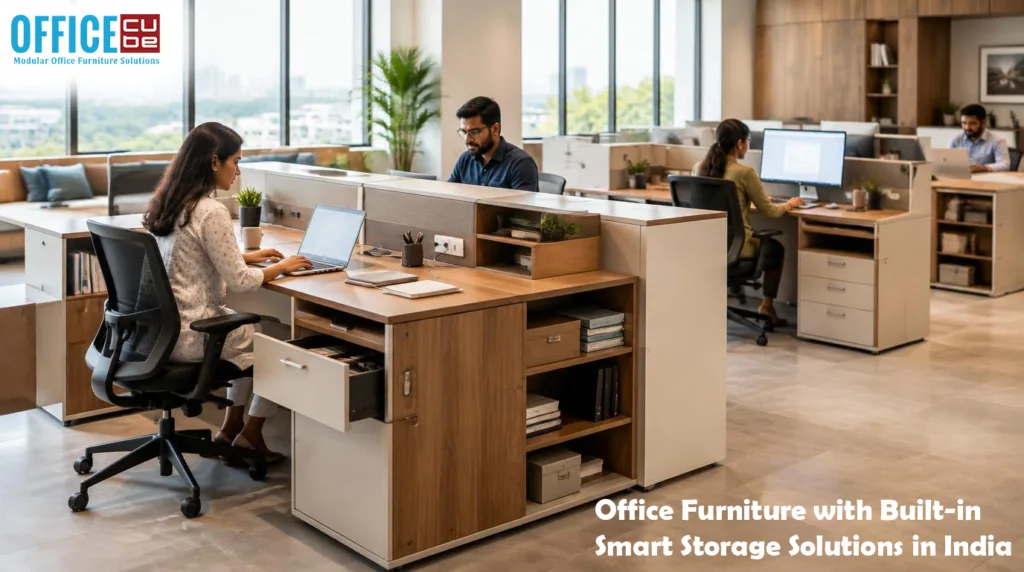
Walking into a well-organized office can change the way the entire workplace feels. There is less visual clutter, fewer distractions, and a sense that everything has its place. That is exactly where office furniture with built-in smart storage solutions in India is becoming increasingly useful. Instead of treating desks, cabinets, shelves, and storage units as completely separate pieces, modern office furniture can combine working surfaces, organization, technology, and space management into a single practical design.
This approach is especially relevant in Indian workplaces, where available office space can vary dramatically. A large corporate office may have dedicated departments, meeting rooms, breakout zones, and storage areas, while a small business might be working from a compact commercial unit where every square foot matters. Home offices create another challenge because professional workspaces often need to share a room with other household activities. In each situation, furniture that performs more than one job can make the environment easier to manage.
The idea of smart storage does not necessarily mean expensive furniture filled with sophisticated electronics. Sometimes, the smartest solution is remarkably simple: a desk with a concealed drawer for stationery, a partition with integrated shelves, a workstation with cable channels, or a storage cabinet designed to use vertical space efficiently. The goal is to reduce unnecessary movement and make frequently used items accessible without allowing them to dominate the workspace.
For Indian businesses, this shift also changes the way furniture should be evaluated. Price remains important, but it is only one part of the equation. Buyers increasingly need to consider space utilization, durability, ergonomics, adaptability, maintenance, technology compatibility, and future expansion. A cheaper desk that creates clutter or becomes impractical after a year may not offer the same long-term value as a thoughtfully designed workstation.
Smart storage is therefore less about adding more cupboards and more about making existing office space work harder. When storage becomes part of the furniture itself, the office can feel cleaner and more intentional without sacrificing functionality.
Why Smart Storage Is Changing Indian Offices
The traditional office often followed a straightforward formula: purchase desks for employees, place filing cabinets along the walls, add a few bookshelves, and find somewhere for printers and other equipment. That arrangement can work, but it can also create awkward gaps between furniture and leave employees surrounded by storage that is not necessarily designed around how they actually work. Modern offices have different requirements. Documents may be digital, employees may use laptops instead of desktop computers, teams may share workstations, and offices may need flexible layouts that can change as the business grows.
This is where smart storage furniture becomes useful. Rather than adding storage after the workspace has already been designed, integrated storage starts with the workflow. What does an employee need close at hand? Where should personal belongings go? How can cables be kept away from feet and walking paths? Where can files, stationery, devices, and office supplies be stored without consuming valuable floor area? These questions can shape the furniture itself.
For Indian offices, space efficiency is particularly relevant because commercial real estate costs and office configurations differ substantially between locations. A compact office in Mumbai, Bengaluru, Delhi, Pune, Hyderabad, or Nagpur may have very different spatial constraints from a large corporate facility. Even within the same city, a startup, a law firm, a design studio, and a back-office operation can have completely different storage needs.
Smart storage also supports cleaner visual design. Instead of having numerous independent cabinets scattered around the room, storage can be incorporated into workstation partitions, credenzas, wall units, reception counters, or collaborative furniture. This can create a more cohesive appearance while reducing the number of disconnected objects in the workspace.
Another important change is the rise of hybrid working. An employee may not need a permanent desk packed with personal belongings every day. Shared desks and flexible workstations can benefit from secure compartments where users can temporarily store laptops, documents, headphones, chargers, and other belongings. A desk that provides a practical storage solution can therefore support flexibility without turning the office into a collection of abandoned bags and accessories.
The result is a workplace where furniture does more than provide a surface to sit and work at. It becomes part of the office’s organizational system.
From Traditional Cabinets to Integrated Storage
Traditional cabinets are not disappearing, and they still have a practical role in many workplaces. The difference is that they no longer have to carry the entire responsibility for office storage. Integrated furniture can distribute storage throughout the workspace, making commonly used items easier to reach while reserving larger cabinets for less frequently accessed materials.
Consider a workstation with a modest pedestal underneath the desk. It can provide drawers for stationery and personal items without requiring a separate cabinet. A larger shared workstation can include a central storage spine containing drawers, shelves, and cable-management routes. A meeting table might incorporate power access so employees do not have to run extension cords across the floor. A reception counter can include concealed compartments for documents and equipment while maintaining a clean front-facing appearance.
These details may appear small individually, but together they can change how an office operates.
The distinction between storage furniture and furniture with storage is useful here. A conventional filing cabinet is primarily a storage product. A smart workstation, on the other hand, may provide a working surface, modest storage, privacy, power management, and cable organization in one system. The latter can be particularly valuable when floor space is limited.
Integrated storage can also reduce visual noise. Open shelves have their place, particularly when companies want to display books, awards, plants, or brand materials. But not every object needs to remain visible. Concealed drawers and cabinets allow everyday clutter to disappear from sight while keeping essential items nearby.
The best designs generally combine both approaches. Open storage can support quick access and visual identity, while closed compartments can handle documents, personal possessions, cables, and supplies that would otherwise make the workspace look untidy.
This does not mean every office should purchase the most complicated furniture available. In fact, excessive features can make furniture harder to maintain. A smart solution should be understandable, durable, and useful in everyday work. The smartest storage is often the storage people actually use.
Key Features of Smart Office Furniture
Smart office furniture can mean different things to different buyers, but several features consistently make a difference in practical workplace design. The first is modularity. Modular furniture allows components such as desks, pedestals, shelves, partitions, and storage units to be rearranged as the organization changes. That flexibility can be valuable for businesses that expect their teams or office layouts to evolve.
Another important feature is concealed storage. Drawers, lockable compartments, overhead cabinets, and integrated shelves can keep essential items accessible without covering the desk surface. This is particularly useful for employees who work with both physical and digital materials. Even in a highly digital office, there are usually notebooks, stationery, documents, chargers, headphones, adapters, and other objects that need a home.
Cable management is another defining feature of modern office furniture. A desk can look beautifully organized until several power cables, USB cables, monitor wires, and charging leads appear. Built-in cable trays, grommets, vertical cable channels, and concealed routing can help keep these wires under control. Good cable management also has a practical safety benefit because loose cables can become trip hazards or interfere with cleaning.
Lockable storage can be equally important. Offices frequently contain confidential papers, devices, employee belongings, or business equipment that should not be left openly accessible. Integrated lockable drawers or compartments can provide a simple layer of organization and security without requiring a separate storage unit.
Some furniture systems also incorporate charging points and connectivity. Depending on the design, a workstation may include access to electrical outlets, USB charging, or other connectivity options. The exact configuration should be selected based on the equipment employees actually use rather than adding technology simply because it sounds modern.
Material quality matters too. Smart functionality cannot compensate for furniture that is unstable, difficult to clean, or poorly suited to intensive office use. In India, buyers should consider factors such as surface durability, resistance to everyday wear, hardware quality, edge finishing, moisture exposure, and the availability of replacement components.
A useful way to think about these features is to ask whether each one solves a real workplace problem. If a concealed compartment saves employees from searching through a drawer every morning, it has value. If cable routing keeps a shared workstation organized, it has value. If a complicated electronic feature is rarely used and difficult to repair, its practical value may be much lower.
Modular Storage, Cable Management, and Hidden Compartments
These three elements can work together particularly well in compact offices. Modular storage provides flexibility, cable management keeps technology organized, and hidden compartments control visual clutter. Together, they allow a workstation to remain functional without becoming crowded.
Imagine a four-person workstation. Instead of placing a separate cabinet beside every desk, the central structure could contain shared storage, while individual workstations include smaller personal drawers. Power and data cables can travel through concealed channels beneath the work surface. Frequently used stationery can remain in accessible drawers, while documents that require restricted access can be placed in lockable compartments.
This arrangement also creates a clearer distinction between individual and shared storage. That distinction matters because employees often accumulate small personal items even when the office has plenty of communal storage. Providing each user with a designated space reduces the temptation to leave belongings on the desk or in common areas.
Hidden compartments can be particularly useful for technology. Headsets, laptop accessories, adapters, keyboards, mice, and charging equipment can quickly become visual clutter when left on a desk. A properly designed compartment gives these objects a predictable home. The objective is not to hide everything; it is to keep the working surface available for the activity that matters most.
Modularity becomes even more useful when the office changes. A company might begin with six employees and later expand to twelve. Fixed furniture can make that transition awkward, whereas modular systems may allow additional workstations or storage modules to be incorporated. The exact level of flexibility depends on the furniture system, so buyers should ask about compatible additions before making a purchase.
This is one reason it is useful to think beyond the immediate installation. Office furniture is an infrastructure decision as much as a décor decision. A desk may look attractive on delivery day, but its real performance becomes apparent months later when employees use it every day, the company adds equipment, and the workspace begins to evolve.
Types of Smart Storage Furniture for Indian Workspaces
There is no single type of smart storage furniture that suits every Indian office. A compact startup may prioritize desks with under-table storage, while a law office may require extensive document storage. A technology company may focus on cable management and device organization, whereas a consulting firm might need flexible workstations that support both individual and collaborative work.
Smart desks are one of the most recognizable options. Depending on their configuration, they can include drawers, pedestals, modesty panels, cable trays, power access, monitor support, or integrated shelving. Their advantage is straightforward: employees receive both a working surface and storage without necessarily requiring a separate cabinet.
Workstation systems take this idea further. A workstation can be designed as a single unit or arranged in clusters for multiple employees. Storage may be placed underneath the desk, between facing workstations, along a central spine, or in overhead units. Such systems are often useful in offices where several employees perform similar tasks and need a consistent layout.
Credenzas and low storage units can provide another option. Positioned along a wall or behind workstations, they can hold documents, equipment, stationery, and other materials without consuming as much visual space as taller cabinets. They can also double as surfaces for printers, displays, plants, or office accessories, provided the furniture is designed to support the intended load.
For collaborative areas, storage can be integrated into benches, movable partitions, meeting tables, and shelving systems. A meeting room, for example, can have concealed storage for presentation equipment, stationery, cables, and conferencing accessories. That prevents the room from becoming dependent on a nearby storeroom every time a meeting begins.
Reception areas also benefit from integrated storage. The front desk needs to look uncluttered because it is often one of the first parts of an office visitors see. Concealed drawers and cabinets can keep visitor materials, stationery, documents, and technology organized without turning the reception counter into a storage wall.
The right choice depends on workflow rather than fashion. Smart furniture should follow the way people work, not force people to work around the furniture.
Smart Desks and Workstations
Smart desks are particularly useful when an office wants to combine a clean appearance with everyday functionality. A well-designed desk can provide enough surface area for a monitor or laptop while keeping smaller accessories within reach. Integrated drawers can handle personal items, while cable openings and under-desk channels can keep wires from spreading across the workspace.
Workstations become even more valuable when multiple employees need to share a consistent environment. Modular systems can establish predictable storage locations, which makes it easier for employees to find common supplies and maintain an organized desk. In larger offices, standardized furniture can also simplify maintenance and replacement because components are more consistent.
For Indian workplaces, dimensions deserve careful attention. A visually impressive workstation is not necessarily comfortable if the desk height, legroom, monitor position, or storage placement is poorly considered. Storage should not interfere with the user’s knees or restrict movement. Drawers should open without colliding with adjacent furniture, and cabinets should not obstruct normal circulation routes.
Another consideration is the balance between open and closed storage. An entirely open workstation may look spacious initially but can become cluttered quickly. An entirely enclosed design can make frequently used items inconvenient to access. A combination of accessible open shelving and concealed storage often provides a more practical compromise.
Technology should also be considered from the beginning. If employees use multiple monitors, docking stations, laptops, desk phones, or other equipment, the furniture should provide appropriate cable routing and enough surface area. Charging access should be positioned where it is genuinely useful rather than hidden behind equipment or placed where cables cross the work surface.
Ultimately, the value of a smart desk is measured by the small frustrations it removes from the working day. When employees can sit down, connect their devices, find their essentials, store personal items, and clear the desk without thinking about where everything belongs, the furniture is doing its job quietly in the background.
Space-Saving Office Furniture for Small Indian Offices
Small offices require a different approach to furniture planning. When floor space is limited, simply adding more cabinets can make the room feel smaller and restrict movement. Space-saving office furniture instead attempts to extract more functionality from the same footprint. That can involve vertical storage, multi-purpose furniture, compact workstations, wall-mounted solutions, or furniture that combines several functions.
Vertical space is particularly valuable. Walls often contain unused area above desk height, and carefully designed shelving or cabinets can use that space for documents and supplies. The challenge is to avoid making the office feel crowded or difficult to maintain. Frequently used items should remain accessible, while less frequently needed materials can occupy higher or less convenient storage.
Multi-functional furniture can also reduce the number of separate pieces required. A workstation partition might include shelves. A meeting table might include power access. A reception counter might provide storage underneath. A bench could include personal compartments. Each combination reduces the need to dedicate additional floor space to another independent unit.
Compact offices should also pay attention to circulation. It is tempting to fill every available corner with furniture, but an office that technically fits everything may still be uncomfortable if people cannot move easily. Doors, windows, electrical points, emergency routes, and access to shared equipment all need to be considered before selecting furniture.
For home offices, the challenge can be even greater. A dedicated room is not always available, so a desk may need to fit into a bedroom, living area, or multipurpose room. Furniture with drawers, shelves, and concealed storage can help the work zone disappear visually when the working day ends. That can be especially useful for people who want a clear separation between professional and personal life.
The smartest small-office design is therefore not simply about buying the smallest furniture available. Tiny furniture can create its own problems if it leaves insufficient working space or storage. Instead, the objective is to maximize usable functionality per square foot while preserving comfort and movement.
Vertical Storage and Multi-Functional Designs
Vertical storage works best when it reflects the frequency with which items are accessed. Daily-use materials should be placed at comfortable reach heights, while archived documents and occasional supplies can be stored higher. This simple principle can make a tall storage unit much easier to use.
Multi-functional furniture takes the concept one step further. Consider a wall-mounted workstation with overhead shelving and concealed compartments. It can provide a desk, storage, and display area without requiring several independent pieces of furniture. Another example is a compact workstation with a side storage tower that provides shelves, drawers, and space for equipment while occupying a relatively narrow footprint.
Movable storage can also be useful in flexible offices. A mobile pedestal or compact storage unit can be repositioned as teams change their layouts. However, mobility should not be added without considering stability, floor conditions, and how frequently the unit will actually move.
Foldable and convertible furniture may have a role in multipurpose spaces as well. A meeting room that doubles as a training room, for instance, can benefit from furniture that can be rearranged efficiently. Storage for chairs, presentation equipment, and supplies can be integrated into the room so that employees do not have to transport everything from another part of the office.
Good space-saving design also depends on visual simplicity. Too many shelves, exposed objects, and mismatched storage units can make even a relatively large room feel crowded. Consistent finishes, aligned furniture heights, and a deliberate combination of open and concealed storage can help maintain a cleaner appearance.
For businesses working within a limited footprint, these details matter because every piece of furniture competes for the same finite space. The winning strategy is not to eliminate storage but to integrate it intelligently. A desk, shelf, cabinet, partition, and technology station do not always have to be separate objects. With thoughtful planning, one furniture system can perform several of those jobs at once.
Ergonomics and Smart Storage: Why Both Matter
Storage should never be designed separately from employee comfort. A drawer may technically fit under a desk, but if it repeatedly strikes an employee’s knees, blocks leg movement, or forces awkward posture, it has not produced a smart result. Likewise, an overhead cabinet may provide excellent capacity but become inconvenient if employees frequently need to reach into it throughout the day.
Ergonomic office furniture begins with the user’s position and movement. Desk height, chair adjustment, monitor placement, keyboard position, legroom, and reach distances all influence comfort. Storage needs to fit around those requirements rather than taking priority over them. Employees should be able to access frequently used objects without repeatedly twisting, stretching, or standing unnecessarily.
The relationship between storage and ergonomics becomes particularly important in compact workstations. Under-desk pedestals can be convenient, but their placement needs to preserve adequate legroom. Side cabinets can provide excellent storage, but they should not interfere with chair movement. Overhead storage can be effective for occasional-use materials, but it should not become the primary location for items employees need dozens of times a day.
Ergonomics also involves the broader layout. A printer placed too far away may force unnecessary walking, while one positioned directly beside an employee may create congestion. Shared storage needs to be located where it can serve several people without becoming a bottleneck. The office should work like a well-designed kitchen: frequently used tools remain close, while less frequently used items occupy more distant storage.
Smart storage can actually support healthier routines by encouraging a more organized working environment. When employees have clear places for equipment and personal belongings, they can maintain a more open work surface and adjust their workspace more easily. A clear desk does not automatically guarantee ergonomic comfort, but it gives users more freedom to position their equipment properly.
This is why purchasing decisions should consider storage capacity and ergonomic performance together. A beautiful cabinet cannot compensate for an uncomfortable workstation, and an ergonomic desk becomes less useful if its surface is permanently buried under office supplies.
When planning an Indian office, buyers should therefore evaluate furniture from the seated user’s perspective. Sit at the workstation. Open the drawers. Move the chair. Check legroom. Reach for commonly used items. Connect the equipment employees actually use. Those simple tests can reveal problems that product photographs rarely show.
Smart storage is ultimately human-centered storage. It should make work easier without asking employees to sacrifice comfort to achieve organization.
Technology-Integrated Office Furniture
Technology is now part of almost every modern workplace, which means office furniture has to accommodate far more than paper files and stationery. Laptops, monitors, docking stations, smartphones, chargers, conferencing equipment, power adapters, keyboards, mice, and networking accessories can quickly create a tangled collection of cables and devices. Technology-integrated office furniture addresses this problem by incorporating practical infrastructure directly into the workstation rather than treating cables and connectivity as an afterthought.
A desk with integrated cable management can route wires from the desktop toward concealed channels underneath. This simple feature can make a surprisingly large difference. Instead of allowing charging cables to hang over the front edge of the desk, employees can connect devices through organized routes that keep the work surface clearer. Cable trays can also make cleaning easier because fewer loose wires are lying across the floor or tucked behind furniture.
Power access is another consideration. Modern workstations may incorporate sockets, USB charging ports, or other connectivity options, depending on the furniture design and electrical installation. The exact configuration should always be planned with qualified electrical professionals where permanent electrical work is involved. Furniture should provide convenient access without compromising safety, and buyers should avoid treating built-in charging features as a substitute for proper electrical planning.
Technology integration can also extend to meeting rooms. A conference table may include concealed access for power and connectivity, allowing participants to charge devices without running extension cords across the floor. Storage compartments can hold presentation accessories, remote controls, adapters, microphones, or other equipment. When everything has a defined location, employees spend less time looking for small accessories before meetings.
There is also an aesthetic benefit. A modern office does not necessarily need to display every technological component it contains. Concealing unnecessary cables and accessories allows the furniture and architecture to remain visually clean while keeping technology accessible. That balance is particularly useful for reception areas, executive offices, meeting rooms, and client-facing spaces.
However, buyers should avoid choosing technology features simply because they appear sophisticated. A USB port that becomes outdated, a proprietary component that is difficult to replace, or an electrical feature that requires expensive maintenance may create problems later. Technology should serve the workflow rather than dictate it. Before purchasing, consider which devices employees use today, how those devices may change, and whether the furniture can accommodate future upgrades without requiring complete replacement.
Charging, Connectivity, and Cable Management
Cable management deserves more attention than it often receives because modern desks can have several independent connections operating simultaneously. A typical workstation might support a laptop charger, monitor cable, keyboard, mouse, phone charger, headset, and networking connection. Without a routing system, those cables can quickly overlap, become difficult to identify, and collect dust underneath the desk.
A good furniture system provides clear paths for cables. Desktop grommets can allow wires to pass through the work surface, while under-desk trays can hold power adapters and excess cable length. Vertical channels can route cables toward floor-level connection points without leaving them exposed. These features are relatively simple, but they can significantly improve day-to-day usability.
The location of charging points also matters. If a power socket is hidden behind a cabinet or positioned too far from the user’s equipment, employees may compensate with extension boards. That can undermine the original purpose of an organized workstation. A well-planned desk places connectivity where users naturally need it while keeping cables controlled.
Shared offices need another layer of consideration. If several employees use the same storage or workstation system, cable routes should be clearly separated and accessible for maintenance. IT teams should be able to troubleshoot equipment without dismantling the entire desk. Modular components and removable access panels can make this easier.
A practical purchasing checklist should therefore examine not only whether a product has cable management but how the cable management actually works. Ask where the cables enter, where they travel, whether adapters can be accommodated, whether the channels can be opened, and whether additional cables can be added later. These questions are much more useful than simply looking for the phrase “smart desk” in a product description.
Smart Storage for Home Offices in India
The rise of remote and hybrid work has made home-office furniture an important category in its own right. A home office often has to perform several jobs within a limited area. The same room might be used for professional work during the day and personal activities at other times. This makes compact office furniture with built-in storage particularly useful.
A home-office desk with integrated drawers can keep notebooks, documents, chargers, stationery, and personal work accessories organized without requiring a separate cabinet. Wall-mounted shelves can provide additional capacity without consuming much floor area. A compact storage tower can hold files and equipment vertically, making better use of available height.
Visual organization is especially important at home because a work setup may remain visible after working hours. When papers, cables, headphones, and equipment are spread across a table, the distinction between work and personal space can disappear. Concealed storage allows the workspace to be reset more easily at the end of the day. Simply placing a laptop and accessories inside designated compartments can make the room feel less like a permanent office.
Size selection matters as well. A home-office desk should provide enough room for the equipment the user actually needs without dominating the room. Buyers should measure the available area, including door swings, windows, electrical outlets, and walking paths. It is easy to underestimate the space required for a chair because the desk itself occupies only part of the footprint.
Noise and appearance can also influence the choice. A home office may need furniture that fits an existing interior rather than looking like a conventional corporate workstation. Fortunately, contemporary office furniture is available in many finishes and configurations, allowing buyers to prioritize both functionality and appearance.
Storage requirements depend heavily on the profession. A designer working primarily on a computer may need relatively little paper storage but more room for devices and accessories. An accountant, consultant, educator, or legal professional may require considerably more document storage. The right furniture therefore starts with the user’s actual workflow, not with a generic definition of a home office.
For people working from smaller apartments, convertible or multi-purpose furniture can be especially helpful. A compact desk with drawers and overhead storage can create a dedicated work zone without requiring a separate room. The key is to maintain sufficient ergonomic space rather than reducing the desk to a size that makes comfortable work difficult.
Office Furniture for Startups and Growing Businesses
Startups often face a furniture dilemma. They need professional-looking workplaces, but their employee count and office requirements may change rapidly. Buying a complete fixed installation can make expansion expensive, while choosing the cheapest furniture available can create replacement costs later. Modular office furniture with smart storage offers a middle ground by allowing businesses to build a functional workspace that can evolve.
A startup might initially need six workstations and one meeting table. A year later, the same business could require twelve or twenty workstations. Modular systems can make this transition easier if additional components remain compatible with the original installation. Buyers should therefore ask manufacturers or suppliers about expansion options before purchasing.
Storage should also be planned around the stage of the business. Early-stage teams may have relatively few physical documents but plenty of technology accessories, samples, marketing materials, and shared equipment. As the company grows, administrative records and employee belongings may increase. Furniture that includes flexible storage compartments can adapt more easily than a collection of highly specialized cabinets.
Another advantage is consistency. A modular workstation system can establish a common design language throughout the office. That can make later expansion look intentional rather than patched together. Consistent dimensions and finishes may also simplify replacement if one component becomes damaged.
Budgeting requires a broader perspective. The cheapest furniture is not necessarily the least expensive option over its useful life. If a desk fails, becomes uncomfortable, lacks cable management, or cannot be expanded, the company may eventually spend more on replacement and modification. At the same time, a startup does not necessarily need premium features everywhere. The sensible approach is to prioritize features that have direct operational value.
Modular Furniture That Scales With Your Team
Scalability is one of the strongest arguments for modular furniture. Instead of treating an office installation as a finished object, modular systems treat it as a collection of components that can be reorganized. Workstations can potentially be moved, additional storage can be introduced, and layouts can be adjusted as teams change.
For example, a company might begin with a row of individual desks. As collaboration becomes more important, some of those desks could be rearranged into team clusters. Storage modules can help define zones without constructing permanent walls. In another situation, an organization may move from assigned desks to shared workstations, requiring personal storage compartments rather than large individual pedestals.
The success of this approach depends on compatibility. Buyers should confirm whether future components will match the dimensions, finishes, connectors, and structural systems of the original furniture. A supplier’s willingness to support replacement components can be just as important as the initial purchase price.
Modular furniture also makes relocation easier. Businesses sometimes change premises as they grow, and furniture that can be disassembled and reconfigured may be easier to transport than highly fixed installations. This can reduce disruption during an office move, although professional installation may still be advisable.
The broader principle is simple: buy furniture for the organization you have while leaving room for the organization you may become. That does not mean predicting the future perfectly. It means avoiding designs that make reasonable future changes unnecessarily difficult.
Smart Storage Solutions for Corporate Offices
Corporate offices typically have more complex storage requirements than small businesses. Different departments may handle confidential documents, equipment, supplies, employee records, project materials, and client information. At the same time, corporate workplaces increasingly emphasize clean layouts, collaboration, and flexible working arrangements. Smart storage can help reconcile these competing requirements.
One approach is to divide storage into personal, team, and centralized categories. Personal storage can accommodate employee belongings and daily-use items. Team storage can hold materials shared by a department or project group. Centralized storage can handle archives, bulk stationery, specialized equipment, and documents that do not need to remain at individual desks.
This hierarchy prevents every employee from requiring a large storage cabinet. It also helps the office use floor space more efficiently. Frequently accessed items remain near the people who need them, while less frequently used resources can be stored elsewhere.
Corporate offices may also benefit from integrated storage in partition systems. Partitions can provide visual separation while containing shelves, drawers, acoustic materials, or display areas. This can be useful in open-plan environments where furniture needs to perform several functions simultaneously.
Security is another consideration. Not every document or device should be openly accessible. Lockable drawers and cabinets can provide localized security, while centralized secure storage may be appropriate for sensitive records. Organizations handling regulated or confidential information should also follow their own information-security and records-management requirements rather than relying on furniture alone.
A corporate office can therefore use smart storage as part of a broader workplace strategy. Instead of asking, “How many cabinets do we need?” facility planners can ask, “What should be stored, who needs it, how often is it accessed, and where should it live?” That shift can produce a much more efficient layout.
Reception and Collaborative Areas With Integrated Storage
Reception areas create a particularly strong case for concealed storage. Visitors generally see the reception desk before they see most of the office, so loose documents, stationery, cables, and equipment can quickly create an untidy impression. Integrated drawers and cabinets allow reception staff to keep frequently used materials close without covering the counter.
A reception counter can also include designated areas for visitor supplies, documents, devices, and administrative materials. The furniture should allow employees to access those compartments without repeatedly leaving the reception position. At the same time, storage should not interfere with visitor circulation or create unnecessary visual barriers.
Collaborative areas have different needs. Meeting rooms require technology, writing materials, documents, and sometimes refreshments. Integrated storage can provide a home for these items so employees do not have to carry them into every meeting. A cabinet near a conference table can hold cables, adapters, markers, notebooks, and presentation equipment.
Keeping Shared Spaces Organized
Shared spaces are often harder to keep organized than assigned workstations because no single person feels responsible for every object. Clearly designated storage can solve part of this problem. If every item has an obvious home, returning it becomes a simple routine rather than a decision.
Labels can be helpful in larger offices, particularly for shared supplies. Closed cabinets can prevent visual clutter, while open shelving can make frequently accessed resources easier to find. The balance depends on how often the items are used.
Mobile storage can also support flexible collaboration. A compact unit can move with a project team, carrying documents, stationery, or equipment between areas. However, the unit should not become an obstacle in circulation paths.
The most effective shared storage systems are intuitive. Employees should not need a manual to understand where commonly used items belong. Good office design makes organization feel natural rather than creating another administrative task.
Materials Used in Smart Office Furniture in India
Material selection affects the appearance, durability, weight, maintenance, and cost of office furniture. Common furniture systems may use engineered wood panels, laminates, metal components, glass, plastics, fabric, or combinations of these materials. The appropriate choice depends on the intended application rather than one material being universally superior.
Engineered wood-based panels are widely used because they can provide a practical combination of appearance, manufacturing flexibility, and cost. Laminate finishes can offer a wide range of colors and textures while being relatively straightforward to maintain. Metal is commonly useful for frames, legs, storage structures, and hardware because it can provide structural strength when appropriately engineered.
Glass can create a visually lighter appearance and may be useful in partitions, cabinets, and meeting furniture. However, buyers should consider cleaning requirements, privacy, impact resistance, and the specific type of glass used. Fabric can contribute to acoustic or aesthetic elements but may require more careful maintenance in high-traffic areas.
Hardware deserves special attention because drawers and doors may be opened hundreds or thousands of times over the life of a workstation. Hinges, runners, locks, handles, connectors, and adjustment mechanisms can have a major impact on the user experience. A furniture product may have an attractive surface but still perform poorly if its hardware is weak.
Indian climate and workplace conditions should also influence material decisions. Dust, humidity, temperature variation, cleaning routines, and exposure to sunlight can affect different finishes differently. The right choice depends on the building and environment, so buyers should ask suppliers about recommended maintenance and expected performance.
Sustainability is another growing consideration. Buyers can ask about material sourcing, durability, repairability, recycled content where applicable, and disposal options. Furniture that lasts longer can reduce replacement frequency, which is one practical part of a more sustainable purchasing strategy.
Custom vs Ready-Made Smart Office Furniture
The choice between custom-made and ready-made furniture depends on the complexity of the workspace. Ready-made systems can be quicker to purchase and may offer predictable pricing, established dimensions, and standardized components. They can be particularly practical for straightforward offices where standard desks and storage units fit comfortably.
Custom furniture becomes more useful when the space has unusual dimensions, architectural constraints, or highly specific storage requirements. An office with awkward columns, limited wall space, unusual corners, or specialized equipment may benefit from furniture designed around those conditions.
Customization can also support branding. A company may want particular colors, finishes, materials, or configurations across reception areas and workstations. However, custom work can involve longer lead times, additional design coordination, and potentially higher costs.
Which Approach Fits Different Workspaces?
A small office with standard dimensions may find ready-made modular furniture sufficient. A corporate headquarters with a carefully planned interior may benefit from a combination of standard workstation systems and custom reception or meeting-room furniture. A specialized workplace may need more extensive customization because its equipment and workflows cannot be accommodated by conventional dimensions.
The key is not to assume that customization automatically means better furniture. Customization has value when it solves a specific problem. If a standard modular cabinet fits the available wall perfectly and provides the necessary capacity, custom fabrication may add unnecessary complexity.
Conversely, forcing standard furniture into a difficult room can waste space and produce awkward compromises. The right question is not “custom or ready-made?” but “which approach uses this particular space most effectively?”
How to Choose Smart Office Furniture in India
Choosing smart office furniture should begin with a workspace audit rather than a product catalogue. Measure the room, identify work zones, understand employee numbers, list equipment, and estimate storage requirements. Consider what employees use every day, what they use occasionally, and what can be moved into centralized storage.
Next, identify the problems the furniture needs to solve. Is the office too crowded? Are cables difficult to manage? Do employees lack personal storage? Are meeting rooms filled with equipment? Is the business likely to expand? Clear answers make furniture selection considerably easier.
Ergonomics should remain a central criterion. Check desk dimensions, legroom, chair compatibility, monitor positioning, and access to drawers. Employees should not have to sacrifice comfort simply because storage has been integrated into the workstation.
Storage capacity should be evaluated realistically. Look at the dimensions and internal organization of drawers and cabinets rather than relying solely on the number of compartments. A cabinet with several small sections may be less useful than one with fewer but appropriately sized spaces.
Then examine quality and service. Ask about warranties, replacement parts, installation, maintenance, and after-sales support. If a drawer runner fails two years later, knowing whether replacement hardware is available can be more valuable than a minor discount at the time of purchase.
Finally, compare the furniture against the entire office layout. A product can be excellent on its own and still be unsuitable for the room if it blocks circulation or creates awkward gaps.
Budgeting for Smart Storage Office Furniture
Budgeting should consider the complete lifecycle of the furniture rather than only the initial invoice. Costs can include furniture, delivery, installation, electrical work, accessories, customization, maintenance, and future additions. A realistic budget therefore begins with the complete project rather than the price of individual desks.
Businesses should also distinguish between essential and optional features. Cable management may be essential for technology-heavy workstations, while specialized accessories may not be necessary for every employee. Similarly, lockable storage may be essential for certain departments but unnecessary in open shared-storage areas.
Buying purely on price can create hidden costs. Furniture that breaks easily, cannot be repaired, or does not accommodate changing needs may require replacement sooner. On the other hand, paying for sophisticated features that employees never use does not necessarily represent good value.
A practical approach is to divide the budget into functional categories: workstations, seating, storage, meeting furniture, reception furniture, technology integration, and installation. This makes it easier to see where money is being spent and where standardization can reduce costs.
For growing companies, it can also be useful to budget for future expansion. If the initial furniture system can accept additional modules later, the organization may avoid replacing everything when the team grows.
The objective is not to spend the most or the least. It is to achieve the right combination of functionality, durability, flexibility, and appearance for the organization’s actual requirements.
Installation, Maintenance, and Long-Term Durability
Even well-designed furniture can perform poorly if installation is careless. Workstations need to be assembled correctly, doors and drawers need proper alignment, and modular systems need to be secured according to manufacturer requirements. Where electrical or technology integration is involved, installation should also follow appropriate professional standards.
Maintenance should be considered before purchasing. Surfaces need regular cleaning, moving components need inspection, and damaged hardware should be repaired before small problems become larger ones. A loose hinge or worn drawer runner may be inexpensive to fix when addressed early but frustrating when it causes a cabinet to become unusable.
Office furniture also experiences different levels of wear. A reception counter may receive constant public interaction, while a storage cabinet used for archives may experience far less movement. Furniture specifications should therefore match the intensity of use.
Durability is closely linked to repairability. Replaceable handles, runners, locks, panels, and other components can extend useful life. A product that can be repaired rather than discarded may provide stronger long-term value.
Cleaning practices matter as well. Different finishes may have specific recommendations, and aggressive cleaning products should not automatically be assumed to be appropriate. Employees and facility teams should follow the manufacturer’s care guidance.
The smartest investment is often furniture that continues performing without demanding constant attention. Durability is not glamorous, but it is one of the most important features in an office that operates every working day.
Sustainable and Space-Efficient Office Furniture Trends
Sustainability in office furniture is moving beyond simply selecting a particular color or material. Businesses are increasingly interested in how furniture is manufactured, how long it lasts, whether components can be repaired, and what happens when the product reaches the end of its useful life.
Space efficiency is part of that conversation. Furniture that performs several functions can reduce the total quantity of products required. A workstation with integrated storage may eliminate the need for a separate small cabinet. A partition with shelving can combine spatial division and storage. A meeting table with integrated connectivity can reduce the need for loose accessories.
Longevity also matters. Replacing furniture frequently can consume more resources than purchasing durable products designed for extended use. Buyers can therefore consider warranties, replaceable parts, construction quality, and the supplier’s support infrastructure.
Modularity supports sustainability in another way. If one component becomes damaged, the entire furniture system may not need to be discarded if individual parts can be replaced. Similarly, businesses that relocate may be able to reconfigure existing furniture instead of purchasing a completely new installation.
Second-life possibilities can also be considered. Furniture that is no longer needed in one department may potentially be reused elsewhere if its configuration allows it. This requires organizations to think about furniture as an asset rather than a disposable office accessory.
Sustainable purchasing does not require every company to choose the same materials or products. It means examining the complete lifecycle and asking practical questions about resource use, durability, maintenance, adaptability, and disposal.
Common Mistakes When Buying Smart Office Furniture
One common mistake is buying furniture based entirely on appearance. A beautiful workstation can still be uncomfortable, difficult to maintain, or poorly suited to the organization’s workflow. Photographs rarely reveal whether drawers interfere with legroom or whether cables can actually be routed conveniently.
Another mistake is underestimating storage requirements. Some buyers focus on desk dimensions while forgetting printers, stationery, documents, employee belongings, technology accessories, and shared equipment. Once the office is occupied, those items have to go somewhere.
The opposite problem also occurs: purchasing excessive storage. Large cabinets can consume valuable space while remaining partially empty. A storage audit before buying can help distinguish actual requirements from assumptions.
Buyers can also overlook future changes. A fixed installation may look ideal for today’s team but become restrictive after a business expands or changes its working model. Modular options can provide useful flexibility where growth is expected.
Ignoring cable management is another frequent problem. Modern workstations contain enough technology to create substantial clutter, and adding cable solutions later can be more difficult than designing them into the furniture from the beginning.
Finally, some organizations focus so heavily on initial cost that they overlook installation, maintenance, warranty coverage, and replacement parts. The purchase is not finished when the furniture arrives; its useful life has only begun.
How Smart Storage Improves Office Productivity
It would be inaccurate to claim that a particular piece of furniture automatically makes employees more productive. Productivity depends on many factors, including management, technology, processes, workload, working conditions, and individual circumstances. However, office design can influence the amount of friction employees experience while completing routine tasks.
Storage is one such source of friction. When people repeatedly search for documents, chargers, stationery, adapters, or equipment, those small interruptions accumulate. Clearly defined storage locations can make common items easier to locate and return.
A clean work surface can also support better task organization. It does not guarantee concentration, but it can make it easier to arrange documents, position monitors, and maintain a consistent workstation. Employees can spend less time moving objects simply to create enough room to work.
Shared storage can improve team coordination as well. If supplies have designated locations and everyone understands the system, employees do not need to repeatedly ask where something is kept. Meeting rooms can similarly operate more smoothly when presentation equipment and accessories are stored close to where they are used.
There is also a psychological dimension to the environment, although individual responses vary. A well-organized workplace may feel calmer and more intentional than one filled with unmanaged clutter. The important point is not to promise a direct productivity percentage but to recognize that good furniture can remove avoidable obstacles from everyday work.
Smart storage works best when it becomes almost invisible. Employees should not spend their day thinking about the storage system. They should simply know where things belong, reach them when needed, and put them away when finished.
Future of Smart Office Furniture in India
The future of office furniture in India is likely to involve greater integration between physical workspace design, technology, flexibility, and employee needs. The exact products will continue to change, but the underlying demand is clear: businesses want furniture that can adapt rather than remain fixed while their working models evolve.
Hybrid work may continue influencing how organizations think about personal storage. If employees spend part of their working week away from the office, organizations may require fewer permanently assigned storage-heavy desks and more shared workstations with secure personal compartments.
Technology will also continue changing workstation requirements. Devices become smaller, connectivity standards evolve, and meeting technology becomes increasingly integrated into office environments. Furniture manufacturers therefore need to design systems that can accommodate change without requiring complete replacement.
Modularity is likely to remain important because businesses rarely remain static. Teams grow, departments move, office layouts change, and companies relocate. Furniture that can be reconfigured can respond to those changes more easily than highly fixed systems.
Sustainability will also remain an important purchasing consideration. Businesses may increasingly examine product lifespans, materials, repairability, and reuse rather than considering furniture purely as a short-term fit-out expense.
The concept of smart furniture may eventually include more connected features, but technology should remain secondary to usability. A workstation does not become intelligent merely because it contains electronics. The real intelligence lies in how effectively the furniture responds to human needs, space limitations, workflow, and future change.
For Indian offices, that principle is particularly valuable because workplace environments vary so widely. There is no universal smart-office template. The most useful furniture will be the furniture that adapts intelligently to the people and space it serves.
Conclusion
Office furniture with built-in smart storage solutions in India represents a practical shift from simply filling an office with desks and cabinets toward designing a complete working environment. Integrated drawers, concealed compartments, modular storage, cable-management systems, technology access, and multi-functional workstations can help organizations make better use of available space while keeping everyday items organized.
The most important consideration is not how many features a furniture product contains. It is whether those features solve real problems. A compact workstation that provides personal storage, sensible cable routing, sufficient legroom, and a durable working surface can be more useful than an expensive desk filled with unnecessary technology. Similarly, a modular storage system that can expand with a growing business may offer more long-term value than a fixed installation that becomes unsuitable after a few years.
Indian businesses should therefore evaluate furniture through the lens of workflow, space, ergonomics, storage, technology, durability, maintenance, and future flexibility. Small offices can benefit from vertical and multi-functional designs, corporate environments can organize storage into personal and shared zones, and home offices can use concealed storage to create a cleaner transition between professional and personal life.
Smart storage is ultimately about making the office easier to use. When employees know where their belongings belong, cables stay controlled, equipment is accessible, and furniture supports rather than interrupts their work, the workplace becomes more organized without demanding constant effort. That is the real value of smart office furniture: not technology for its own sake, but thoughtful design that quietly makes everyday work more manageable.
Frequently Asked Questions
1. What is smart storage in office furniture?
Smart storage refers to furniture that integrates storage into the workstation or surrounding structure rather than relying entirely on separate cabinets. Examples include built-in drawers, lockable compartments, shelving, storage partitions, concealed cable areas, mobile pedestals, and multi-functional workstation systems. The purpose is to make storage more accessible while using available office space efficiently.
2. Is smart office furniture suitable for small offices in India?
Yes. Small offices can particularly benefit from integrated storage because it can combine several functions within a limited footprint. Vertical cabinets, compact workstations, under-desk pedestals, storage partitions, and multi-purpose furniture can help reduce the number of separate units required. However, storage should always be planned alongside circulation and ergonomic requirements.
3. What should I check before buying office furniture with built-in storage?
Check the furniture’s dimensions, material quality, storage capacity, drawer and door hardware, cable-management system, ergonomic clearances, warranty, installation requirements, and availability of replacement parts. Also consider how many employees will use the furniture and what equipment they need. If the business is likely to expand, investigate whether additional modules can be purchased later.
4. Can smart office furniture help with cable management?
Yes. Many modern workstation systems can include cable grommets, under-desk trays, vertical cable channels, concealed routing, and access points for power and connectivity. These features can reduce visible cable clutter and make workstations easier to maintain. The exact configuration should be matched to the devices and electrical requirements of the workplace.
5. Is custom office furniture better than ready-made furniture?
Neither option is universally suitable. Ready-made modular furniture can work well where standard dimensions meet the needs of the office, while custom furniture can be useful for unusual spaces, specialized workflows, or specific design requirements. The appropriate choice depends on the room, budget, storage needs, expansion plans, and level of customization required.