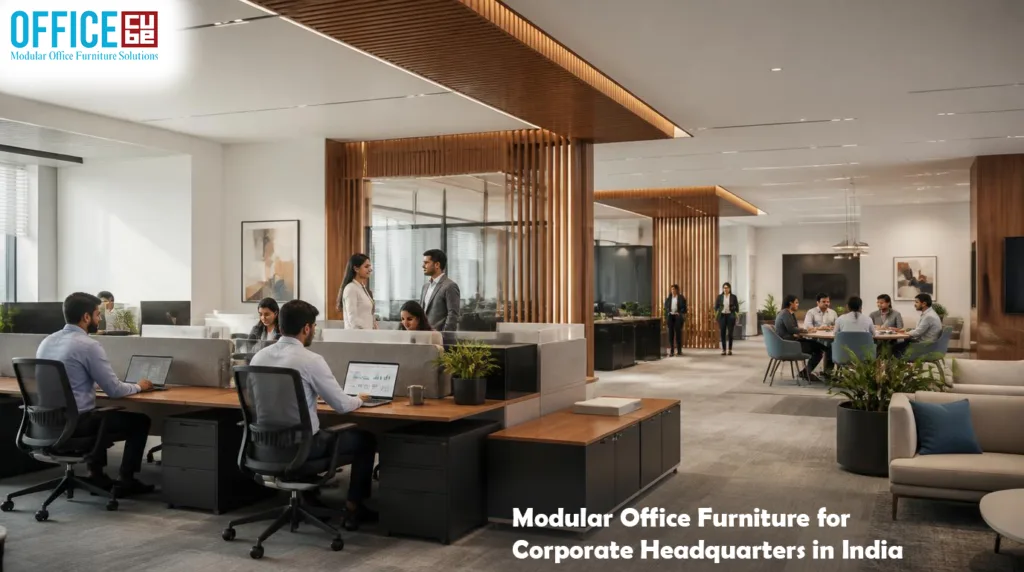
A corporate headquarters is much more than a collection of desks, chairs, cabins, and meeting rooms. It is the physical expression of a company’s culture, ambition, leadership style, and attitude toward its people. That is why choosing modular office furniture for corporate headquarters in India requires more thought than simply selecting attractive products from a catalogue. A successful headquarters needs furniture that can support focused work in the morning, collaboration in the afternoon, leadership meetings later in the day, and changing business requirements months or years down the road.
This is where modular furniture becomes particularly useful. Unlike conventional fixed furniture, modular systems are designed around flexibility. Workstations can be rearranged, meeting areas can be expanded, storage can be repositioned, and departments can adapt their layouts without completely rebuilding the workplace. For growing Indian companies, that flexibility can be extremely valuable. A headquarters that looks perfect on opening day should not become inefficient simply because the organisation hires more employees, changes team structures, adopts hybrid work, or introduces new technology.
The best office furniture therefore sits at the intersection of design, ergonomics, technology, durability, brand identity, and operational practicality. It should look polished enough for clients and senior executives while remaining comfortable for employees who spend long hours using it. It should also cope with India’s diverse workplace requirements, from air-conditioned corporate towers in Mumbai and Bengaluru to large headquarters campuses in Delhi NCR, Hyderabad, Chennai, Pune, Ahmedabad, and other business centres.
Why Modular Furniture Fits Modern Indian Corporate Headquarters
Corporate workplaces are changing quickly. Teams are becoming more fluid, employees may divide their time between home and office, and companies increasingly want offices that encourage people to collaborate rather than simply sit at assigned desks. At the same time, headquarters continue to perform an important representational role. Clients, investors, business partners, recruits, and senior stakeholders may all walk through the same reception area and meeting spaces.
Modular office furniture provides a practical way to handle these competing demands. Instead of treating the office as a permanent arrangement, modular planning treats it more like an adaptable framework. The furniture can respond when the organisation changes. That distinction matters because corporate real estate is a long-term investment, while organisational structures can change much faster.
A well-planned modular workplace can combine open workstations with private cabins, informal collaboration zones, enclosed meeting rooms, touchdown spaces, storage walls, breakout areas, and executive environments. These elements can share compatible finishes and design language, allowing the entire headquarters to feel coherent rather than assembled from unrelated products.
For Indian businesses, another advantage is the ability to balance premium appearance with practical cost control. Not every part of a headquarters needs the same specification. A company might invest heavily in executive areas and client-facing meeting rooms while selecting highly durable, efficiently manufactured workstation systems for larger employee zones. Modular planning makes that segmentation easier.
The result is an office that feels intentional rather than merely expensive. Good furniture should not shout for attention. It should make the workplace feel organised, comfortable, capable, and distinctly connected to the company behind it.
Designing for Flexibility, Growth, and Changing Workstyles
Flexibility should be considered from the beginning of the furniture-planning process rather than added later as an emergency solution. Imagine a company occupying an office for five years. During that period, one department may double in size, another may become smaller, teams may move from fixed seating to hybrid schedules, and new functions may appear that were not part of the original plan. A rigid furniture layout makes every organisational change expensive and disruptive. A modular system gives the company more room to respond.
One of the strongest characteristics of modular furniture is reconfigurability. Workstations can be arranged in clusters, rows, pods, or team neighbourhoods depending on the work being performed. Screens can provide varying levels of visual separation without requiring permanent walls. Storage can help define zones, while mobile or modular meeting furniture can allow spaces to serve multiple purposes.
This is particularly useful in headquarters where different departments have different working patterns. Finance may require concentrated desk-based work and secure storage. A creative or product team may need large collaborative surfaces. Human resources may require confidential conversation areas. Sales teams may benefit from touchdown spaces and small meeting rooms. Senior management may need private offices combined with shared boardrooms and strategy rooms.
A good modular system allows these requirements to coexist without making the workplace feel fragmented. The design language can remain consistent while the configuration changes from one area to another.
Flexibility also has a financial dimension. If a company can relocate or reconfigure existing components rather than discard an entire furniture installation, the useful life of the investment can increase. That makes modular furniture particularly attractive for businesses that expect expansion, relocation, mergers, restructuring, or changing workplace policies.
The smartest approach is therefore to design not only for today’s headcount but also for tomorrow’s organisational possibilities.
Balancing Executive Image With Everyday Functionality
A corporate headquarters has a public-facing personality. Reception areas, executive offices, boardrooms, client lounges, and important meeting spaces often shape the first impression visitors receive. Yet an impressive headquarters should never sacrifice the everyday needs of employees simply to create a premium visual statement.
The challenge is finding a balance between corporate aesthetics and workplace performance. Modular furniture can help because different configurations and finish combinations can create distinct environments while maintaining a common design identity. A company may use refined wood-look finishes and premium seating in executive areas, for example, while using durable laminates, practical storage, and ergonomic workstations across larger employee zones.
The reception area can establish the visual language of the headquarters. From there, that language can continue subtly through workstation screens, meeting tables, storage systems, conference furniture, and executive desks. Consistency does not mean every room must look identical. In fact, excessive uniformity can make a large headquarters feel sterile.
Instead, think of the furniture as a corporate vocabulary. Colours, materials, textures, proportions, and details are the words. Different spaces use that vocabulary differently.
Function remains essential. A beautifully designed executive desk with inadequate cable management can quickly become cluttered. A stylish conference table without accessible power creates frustration during meetings. An attractive workstation with poor ergonomic adjustment can negatively affect the employee experience.
The strongest headquarters design therefore asks two questions simultaneously: Does this furniture represent our brand? and Does this furniture help people do their jobs well? When the answer to both is yes, aesthetics stop being decoration and become part of the workplace strategy.
Key Modular Furniture Solutions for Corporate HQs
There is no single furniture product that defines a modern headquarters. The most successful environments usually combine several modular systems that work together. The exact mix depends on headcount, business type, floor plate, leadership structure, technology requirements, and workplace culture.
A typical corporate headquarters may require open workstations, team benches, private cabins, executive desks, meeting tables, conference seating, reception counters, storage, collaborative furniture, breakout seating, and specialised spaces for training or project work. The objective is not to fill every available square metre. It is to create an ecosystem in which different types of work can happen naturally.
Modularity becomes valuable because these elements can be planned as a coordinated system. Workstations can connect to storage. Storage can define circulation routes. Meeting tables can integrate power. Screens can create privacy. Desks can be resized or rearranged as team requirements evolve.
This system-based approach is also useful during procurement. Instead of purchasing every item independently, organisations can establish a design standard and then apply it across departments. That can make the final environment more cohesive and simplify replacement or expansion later.
For large Indian corporate headquarters, standardisation can be especially useful when several floors or buildings are involved. A company may establish a common workstation family, seating specification, colour palette, storage strategy, and meeting-room standard while allowing each business unit some flexibility.
The goal is not to make every employee’s surroundings identical. The goal is to make the workplace consistent enough to feel like one organisation and flexible enough to support different kinds of work.
Modular Workstations and Collaborative Benching
Workstations are usually the largest furniture investment in an office, so their design deserves careful attention. A workstation needs to accommodate the employee, monitor or monitors, keyboard, documents, personal belongings, technology accessories, and sometimes task-specific equipment. At the same time, it must fit efficiently into the floor plan without making circulation feel cramped.
Modular benching systems are popular because they can provide an efficient arrangement for teams working in shared zones. Desks can be arranged face-to-face, back-to-back, in clusters, or in other configurations depending on the available space and the desired interaction between employees. Screens can provide privacy while maintaining a sense of openness.
The important thing is to avoid choosing a workstation merely because it looks modern in a showroom. The real question is how it performs during an ordinary working day. Can employees adjust their chairs comfortably? Is there enough legroom? Can cables be managed neatly? Is the desk deep enough for the intended equipment? Can storage be reached without interfering with another employee?
Modularity also allows departments to receive different configurations while using the same furniture family. A technology team might need dense workstation clusters. A leadership-support team might need more privacy. A project team might benefit from collaborative tables positioned close to its desks.
Finishes matter as well. High-use corporate furniture should be selected for durability and ease of cleaning rather than visual appeal alone. Neutral colours can create a calm base, while carefully selected brand colours can appear in screens, panels, upholstery, or occasional furniture.
When planned correctly, modular workstations become more than individual desks. They become the basic infrastructure of the corporate workplace, capable of adapting as teams and working styles evolve.
Executive Cabins, Meeting Rooms, and Boardrooms
Executive spaces carry a different responsibility. They need privacy, authority, comfort, and a level of refinement that reflects the organisation’s positioning. Yet modern executive areas do not necessarily need oversized desks or traditional heavy furniture. Contemporary corporate leadership spaces increasingly benefit from cleaner proportions, integrated technology, comfortable meeting arrangements, and adaptable layouts.
An executive cabin can combine a primary desk with a small discussion table, visitor chairs, storage, and technology support. This allows the room to serve several functions without becoming crowded. A senior leader may conduct focused work at the desk, hold a short one-to-one discussion at the side table, or participate in a video meeting without changing rooms.
Boardrooms demand even more careful planning because they are frequently used for high-stakes conversations. Table size, sightlines, chair comfort, acoustic conditions, screen positioning, lighting, and power access all affect the experience. A visually impressive conference table is of little use if participants cannot connect their devices easily.
Modular meeting furniture can make rooms more versatile. Tables can sometimes be divided, rearranged, or configured differently for board meetings, training sessions, workshops, or presentations. Chairs can be selected for long-duration comfort without making the room look overly residential.
Executive furniture should also communicate brand personality. A conservative financial institution may prefer restrained finishes and formal proportions, while a technology company might favour lighter materials, softer shapes, and more informal collaboration spaces.
The best executive environment feels authoritative without being intimidating. It communicates that the company takes business seriously while still recognising that people, not furniture, are the centre of every meeting.
Ergonomics, Employee Experience, and Workplace Productivity
A headquarters can have exceptional architecture and expensive furniture and still feel uncomfortable. The difference often comes down to ergonomics. Employees spend significant portions of their working lives at desks, so small physical inconveniences can become major sources of fatigue when repeated every day.
Ergonomic planning should therefore be treated as a core design requirement rather than a premium feature. Chairs need appropriate adjustability. Desk heights and dimensions should suit the tasks performed. Monitor positioning should support comfortable viewing. Employees should have enough space to move naturally rather than feeling boxed into a workstation.
Modular furniture can support ergonomic planning because it can be configured around different users and activities. Adjustable desks, adaptable monitor supports, movable screens, and properly designed workstation dimensions can help create more individual choice.
Employee experience also extends beyond the workstation. People need spaces for concentration, conversation, informal collaboration, breaks, and private discussions. If every activity happens at the same desk, employees may struggle to find an environment appropriate to the task.
This is why the modern corporate headquarters increasingly works as a portfolio of spaces. Some are designed for individual concentration. Others support teamwork. Some encourage spontaneous interaction, while others protect confidentiality.
Furniture plays a major role in signalling how each area should be used. A high-backed lounge arrangement feels different from an open bench. A small two-person meeting table communicates a different purpose from a large boardroom table.
When these cues are clear, employees can navigate the workplace more naturally. Good furniture does not simply occupy space; it helps people understand what the space is for and how they can use it.
Ergonomic Seating and Adjustable Workstations
The office chair is arguably one of the most important individual furniture choices in a headquarters. Employees may interact with their chairs for hours every day, so comfort, adjustability, support, and durability should be evaluated carefully.
A strong ergonomic chair should allow users to adjust important elements according to their body and working preferences. Seat height, back support, arm positioning, and recline behaviour can all influence comfort. The precise specification should be selected according to the intended users rather than assuming one chair will suit every person equally.
Adjustable workstations can complement ergonomic seating. Sit-stand desks, for example, can introduce greater variation into the working day, although they should be part of a broader ergonomic strategy rather than treated as a magic solution. The objective is not simply to make employees stand. It is to give people greater ability to change posture and work comfortably.
Workstation dimensions also deserve attention. A desk that looks compact on a plan may feel restrictive once a monitor, keyboard, notebook, documents, and other equipment are placed on it. Conversely, oversized desks can consume valuable floor area without delivering meaningful benefits.
For large corporate offices, standardisation can make procurement easier, but standardisation should not eliminate user choice where it matters. A practical strategy is to establish approved ergonomic products and configurations while allowing employees or departments to select from suitable options.
The result is a workplace where furniture supports people rather than forcing people to adapt themselves to furniture. That is a subtle difference, but over years of daily use, it can become one of the most important differences in the entire headquarters.
Acoustic, Privacy, and Wellness Considerations
Open offices can encourage interaction, but they can also create distractions. Conversations, telephone calls, movement, and equipment noise can make concentration difficult when the workplace offers no acoustic or visual separation. Furniture cannot solve every acoustic problem, but it can contribute significantly to a more balanced environment.
Acoustic screens, high-backed seating, strategically placed storage, upholstered panels, and carefully positioned meeting areas can help divide zones without constructing permanent walls. The idea is to create different levels of openness rather than choosing between an entirely open office and a completely enclosed one.
Privacy also has multiple dimensions. Visual privacy may be necessary for employees handling sensitive information. Conversational privacy can matter during HR discussions, client calls, or managerial conversations. Personal privacy can simply mean having an occasional place where an employee can concentrate without constant interruption.
Wellness considerations extend to movement, natural light, greenery, comfortable seating, and access to informal spaces. Furniture should support these goals rather than obstruct them. For example, excessive storage can create visual clutter and reduce openness, while thoughtfully integrated storage can keep work surfaces organised.
A well-designed corporate headquarters should feel active without feeling chaotic. It should have energy without forcing every employee into constant interaction.
This is where furniture becomes part of workplace psychology. A screen can say, “This is a focused zone.” A lounge arrangement can say, “Sit here and talk.” A small enclosed booth can say, “Take this call privately.” These cues help employees manage their attention throughout the day.
Technology-Ready Furniture for Connected Offices
Technology has fundamentally changed what an office desk needs to provide. A workstation may now support multiple displays, laptops, docking equipment, charging devices, headphones, video calls, and other digital tools. Meeting rooms may require displays, cameras, microphones, speakers, wireless presentation systems, and easily accessible power.
Furniture should therefore be designed around technology rather than having technology added as an afterthought. Poorly planned cables can quickly turn an otherwise sophisticated office into a tangled landscape of wires.
Technology-ready modular furniture can incorporate cable trays, vertical cable management, floor-box connections, power modules, data access, and concealed routing. The exact system depends on the building’s services and IT architecture, but the furniture should make those services easy to access and maintain.
This becomes especially important when the headquarters undergoes changes. Technology does not remain static. Devices change, connection standards evolve, and meeting-room requirements can be upgraded. Furniture that provides accessible service routes is easier to modify than furniture that permanently conceals every connection.
Corporate headquarters also need to think about technology from the user’s perspective. A meeting participant should not need to crawl under a table to find an electrical socket. An employee should not have cables crossing a walkway. A video-call participant should have a sensible camera position and background.
The furniture system becomes a quiet piece of technology infrastructure. When it works well, nobody notices it. When it works poorly, everybody notices it.
Cable Management, Power, and Meeting Technology
Cable management may sound like a minor detail during the design stage, but it becomes highly visible once employees occupy the office. Chargers, monitors, docking stations, network connections, and other devices quickly create cable congestion if the furniture does not provide an organised route.
A good modular workstation can separate power and data pathways, provide under-desk management, and allow service access without dismantling the entire desk. This makes maintenance easier and keeps the workplace cleaner.
Meeting rooms require similar thinking. Power and connectivity should be positioned where participants can actually reach them. Larger boardrooms may need integrated connectivity at several points rather than a single power location. Smaller meeting rooms may benefit from compact technology modules that keep the table surface uncluttered.
Video conferencing introduces another layer of consideration. Cameras, microphones, displays, lighting, and acoustics all interact with furniture placement. A beautiful table positioned incorrectly relative to a camera can create a poor meeting experience.
The same principle applies to hybrid work. When some employees are physically present and others join remotely, furniture and room technology need to work together. Clear sightlines and good microphone positioning become essential.
Modularity helps because technology can be upgraded without necessarily replacing the entire furniture installation. Service modules, access panels, cable pathways, and replaceable components can make the workplace more adaptable.
When selecting furniture, corporate buyers should therefore ask suppliers not only about dimensions and finishes but also about how the furniture integrates with the company’s technology standards. That conversation can prevent expensive modifications later.
Smart Layouts for Hybrid and Flexible Work
Hybrid work has changed the relationship between people and desks. A headquarters may no longer need one permanently assigned workstation for every employee, particularly when teams follow different attendance patterns. But that does not mean the office simply needs fewer desks.
The more important question is what employees need when they come into the workplace. They may need touchdown desks for focused work, collaboration areas for team sessions, meeting rooms for client discussions, quiet spaces for video calls, and social zones for relationship building.
Modular furniture can help create this mix. A floor can include standard workstations alongside flexible tables, movable seating, small meeting arrangements, and reconfigurable collaboration zones. Instead of designing every square metre for one fixed activity, the space can support several patterns of use.
However, flexibility should not become randomness. Employees need enough consistency to understand where they can work and what resources are available. Furniture layouts should therefore create recognisable zones with clear functions.
A company can also establish furniture standards for different work modes. For example, a focused-work zone might prioritise ergonomic desks and acoustic separation, while a collaboration zone might use shared tables and mobile whiteboards. A social area might rely on lounge seating and informal tables.
The headquarters then becomes less like a traditional office floor and more like a workplace ecosystem.
This approach is particularly useful for organisations that expect their workplace strategy to evolve. Instead of making one irreversible decision, the company builds a physical platform that can be adjusted as experience reveals what employees actually need.
Materials, Sustainability, and Indian Workplace Requirements
Furniture selection has an environmental and operational dimension that extends far beyond the purchase price. Corporate headquarters can contain thousands of individual furniture components, so the materials selected, manufacturing quality, packaging, transportation, installation process, and eventual replacement strategy all matter.
Sustainable office furniture does not simply mean choosing a product labelled “green.” Buyers should look at the entire lifecycle. Can components be repaired? Can damaged surfaces be replaced? Can workstations be reconfigured? Are materials durable enough to avoid premature replacement? Can parts be separated or recycled at the end of their useful life?
These questions are particularly relevant for modular systems because modularity naturally supports longer-term use. If one component fails, the entire workstation does not necessarily need to be discarded. If a department changes, furniture can potentially be relocated.
Indian corporate headquarters also need to consider local operating conditions. Temperature, humidity, dust, cleaning routines, intensity of use, and maintenance practices can influence material performance. A finish that looks excellent in a showroom should be evaluated for how it will behave after years of daily corporate use.
Procurement teams should also consider the supplier’s ability to support replacement parts and after-sales service. A furniture system is not truly sustainable if minor damage forces the company to replace an otherwise usable product.
Sustainability therefore works best when it aligns with economics. Furniture that lasts longer, can be repaired, and can be reconfigured can reduce waste while protecting the company’s investment.
Choosing Durable and Sustainable Materials
Material selection should begin with the purpose of each space. Employee workstations may experience continuous daily use and therefore require robust surfaces. Executive areas may prioritise premium appearance but still need materials capable of handling regular meetings and cleaning. Breakout spaces may require upholstery designed for repeated use.
Common office furniture materials include engineered wood products, laminates, metal, glass, fabrics, plastics, and upholstery. Each has different characteristics, and no single material is automatically best for every application.
For example, laminate finishes can provide practical durability and a wide range of visual choices. Metal components can offer structural strength. Glass can create visual openness but requires appropriate safety and maintenance considerations. Upholstered panels can contribute to acoustic treatment while introducing colour and texture.
The right question is not “Which material is most premium?” It is “Which material performs best for this particular application over the expected life of the furniture?”
Corporate buyers should also ask suppliers about material certifications and environmental documentation where relevant. Responsible sourcing, emissions considerations, recycled content, and manufacturing practices can all contribute to a more informed purchasing decision.
Durability remains one of the simplest forms of sustainability. A desk that lasts significantly longer and remains useful through several office reconfigurations can be more valuable than a product that looks environmentally attractive but requires frequent replacement.
This is why modularity and sustainable design often reinforce each other. The longer a furniture system can remain functional, the less frequently the organisation needs to purchase, transport, install, and dispose of replacement furniture.
Maintenance, Hygiene, and Long-Term Durability
A corporate headquarters is a high-use environment. Furniture is touched, moved, cleaned, adjusted, and occasionally damaged every day. Maintenance should therefore influence furniture selection from the beginning rather than becoming a facilities problem later.
Surfaces should be easy to clean using appropriate products. High-contact areas such as meeting tables, chair arms, workstation edges, and reception furniture deserve particular attention. Upholstery should be selected according to the intensity and type of use.
Modular construction can make maintenance easier because individual components may be replaceable. If a screen, panel, work surface, or hardware component becomes damaged, the organisation may be able to replace that element without removing an entire furniture system.
This has practical benefits for facilities teams. A repairable workplace creates fewer disruptions than a workplace in which every issue requires a large replacement project.
Durability should also be evaluated at the hardware level. Hinges, drawer mechanisms, height-adjustment components, castors, connectors, and workstation frames can determine whether a product continues to perform properly after years of use.
Corporate buyers should ask about warranty terms, service response, replacement components, installation support, and maintenance guidance before making a large purchase. These details may seem less exciting than colour and design, but they can have a major impact on the total cost of ownership.
The ideal headquarters furniture should age gracefully. It does not have to look brand-new forever. It needs to remain safe, functional, presentable, repairable, and adaptable throughout its intended service life.
Planning, Budgeting, and Procurement for Corporate HQs
Furniture procurement for a corporate headquarters is a multidisciplinary project. Facilities teams, architects, interior designers, HR leaders, IT departments, finance teams, procurement professionals, and senior management may all have legitimate requirements.
A successful project begins with a clear workplace brief. Before discussing colours and finishes, the organisation should understand its headcount, department structure, working patterns, meeting requirements, storage needs, technology standards, employee expectations, and anticipated growth.
The furniture budget should then be connected to those requirements. Treating furniture as a simple cost-per-desk exercise can be misleading because a headquarters requires many different environments. Reception furniture, executive areas, meeting rooms, workstations, ergonomic seating, storage, breakout spaces, and installation can all contribute to the final investment.
Procurement should also evaluate the supplier’s capacity. A large headquarters may require coordinated delivery, installation across multiple floors, punch-list resolution, documentation, and post-installation support. A supplier that offers attractive products but cannot manage the project operationally can create significant problems.
Samples and prototypes are useful before final approval. Employees can test chairs, teams can evaluate workstation dimensions, and IT teams can check technology integration. A full-scale mock-up can reveal issues that are difficult to see on a drawing.
Most importantly, procurement should look beyond the initial invoice. Total cost of ownership includes maintenance, replacement parts, reconfiguration, future expansion, downtime, and eventual replacement.
The best-value furniture is not necessarily the cheapest furniture. It is the furniture that delivers the right combination of performance, flexibility, appearance, durability, support, and lifecycle value.
How to Build a Practical Furniture Budget
A practical budget starts with categorisation. Instead of assigning one generic figure to “office furniture,” divide the project into functional groups. These may include workstations, task chairs, executive furniture, meeting-room furniture, reception, storage, collaboration areas, breakout furniture, technology integration, and installation.
This makes it easier to see where investment is going and where different specifications may be justified. A boardroom used for important client meetings may deserve a different table and chair specification from an internal project room. Likewise, a reception counter has a different purpose from a high-density workstation.
Budgeting should also account for future requirements. If the company expects substantial growth, purchasing only enough furniture for the current headcount may create another procurement exercise soon. On the other hand, buying excessive quantities that sit unused can tie up capital and consume valuable space.
Modular systems provide an opportunity to phase investment. An organisation can establish a standard furniture platform and expand it as teams grow, provided the supplier can maintain product availability and finish consistency.
It is also sensible to reserve budget for installation, modifications, cable management, accessories, and contingency. Furniture projects rarely involve only the visible products shown in a catalogue.
A useful procurement question is: What will happen if we need to change this layout three years from now? If the answer involves replacing nearly everything, the original solution may not be genuinely modular.
A better budget supports flexibility rather than simply purchasing maximum quantity. It recognises that the workplace will evolve and allocates value to the ability to adapt.
Installation, Customization, and Future Expansion
Even excellent furniture can underperform if installation is poorly managed. Corporate headquarters often involve complex floor plates, multiple departments, elevators, access restrictions, building-management requirements, and carefully scheduled move-in dates.
Installation should therefore be treated as part of the furniture solution rather than a separate afterthought. Site measurements, electrical coordination, workstation alignment, circulation clearances, and technology connections should be checked before installation begins.
Customization can also be valuable when used intelligently. Corporate headquarters may require furniture adapted to unusual room dimensions, branding requirements, executive preferences, or technology specifications. However, excessive customization can reduce the benefits of modularity and make future replacement more complicated.
The strongest approach is usually standardisation with controlled customization. Establish a core product family, then modify selected elements where there is a genuine functional or design reason.
Future expansion should be considered at the procurement stage. Ask whether the supplier expects to maintain the same product line, whether additional components can be ordered later, and whether finishes will remain available. Consistency matters when adding workstations several years after the original installation.
Documentation also has long-term value. Maintain furniture schedules, product specifications, layout drawings, warranty information, and component details. Facilities teams can then make informed decisions when furniture needs to be moved, repaired, or expanded.
A corporate headquarters is rarely static. Teams move, companies grow, departments merge, and workplace policies change. The furniture should be able to participate in those changes rather than becoming an obstacle.
Conclusion: Building a Future-Ready Corporate Headquarters
Choosing modular office furniture for corporate headquarters in India is ultimately a decision about how a company wants its workplace to perform over time. The furniture needs to look professional, but appearance is only one part of the equation. A genuinely successful headquarters combines ergonomic comfort, flexible planning, technology integration, durability, maintainability, brand expression, and sensible lifecycle economics.
Modularity is valuable because it recognises a simple reality: businesses change. A department that occupies one floor today may move tomorrow. A team that once needed permanent desks may adopt hybrid working. A meeting room may become a project space. An organisation may expand into another wing or consolidate operations after a strategic change. Furniture that can respond to these situations gives the company more freedom.
The strongest corporate furniture strategy therefore begins with people and workflows rather than products. Understand how employees work. Identify where collaboration happens. Determine which activities need privacy. Plan technology early. Specify ergonomic furniture. Select durable materials. Consider maintenance and future expansion. Then choose modular products that connect all of those requirements into one coherent workplace.
For Indian corporate headquarters, this approach can create offices that feel contemporary without becoming impractical. A successful headquarters does not need to follow every design trend. It needs to provide a dependable environment where people can focus, collaborate, meet clients, lead teams, and adapt to changing business demands.
In the end, great office furniture should almost disappear into the experience of working. Employees should notice that the chair is comfortable, the technology is accessible, the meeting room works, the workspace feels organised, and the environment reflects the company’s identity. When all those details work together, modular furniture becomes more than an interior product. It becomes part of the infrastructure that helps a business operate, grow, and present itself with confidence.
FAQs
1. Why is modular office furniture suitable for corporate headquarters in India?
Modular office furniture is suitable because corporate headquarters often need to accommodate changing teams, different workstyles, technology requirements, and future expansion. Modular systems can be reconfigured instead of requiring a completely new furniture installation whenever the organisation changes. They can also support different environments, including open workstations, private offices, meeting rooms, collaboration areas, and executive spaces, while maintaining a consistent design language. For growing businesses, that adaptability can improve the long-term value of the furniture investment.
2. What should companies consider when choosing modular office furniture?
Companies should consider ergonomics, durability, floor-space efficiency, design, technology integration, cable management, storage, maintenance, flexibility, warranty support, and future expansion. The furniture should match the way employees actually work rather than being selected solely on appearance. Procurement teams should also evaluate the supplier’s ability to deliver, install, service, and provide additional components when the workplace expands or changes. Looking at total cost of ownership rather than only the initial purchase price can lead to a more practical decision.
3. How does modular furniture support hybrid work?
Modular furniture allows offices to provide different environments for different types of work. Instead of assigning every employee a permanent workstation, companies can combine touchdown desks, collaborative tables, meeting spaces, quiet zones, private rooms, and shared workstations. This gives employees greater choice when they come into the office. The exact mix should be based on actual attendance patterns and work requirements rather than assuming that every hybrid workplace needs the same layout.
4. Is modular office furniture more expensive than traditional furniture?
The initial price depends on the specification, materials, configuration, and supplier. However, comparing only the purchase price can miss the main advantage of modular furniture. A well-designed modular system may be rearranged, expanded, repaired, or reused as the organisation changes, potentially reducing the need for complete replacement. The better comparison is therefore based on lifecycle value, including installation, maintenance, reconfiguration, future expansion, and replacement requirements.
5. How can a corporate headquarters make its modular furniture more sustainable?
Sustainability can be improved by choosing durable products, repairable components, responsible materials, efficient layouts, and furniture systems that can be reconfigured rather than discarded. Companies should also consider the supplier’s environmental documentation, manufacturing practices, packaging, replacement-part availability, and end-of-life options where relevant. Extending the useful life of furniture is particularly important because products that remain functional through multiple workplace changes can reduce unnecessary replacement and waste.