
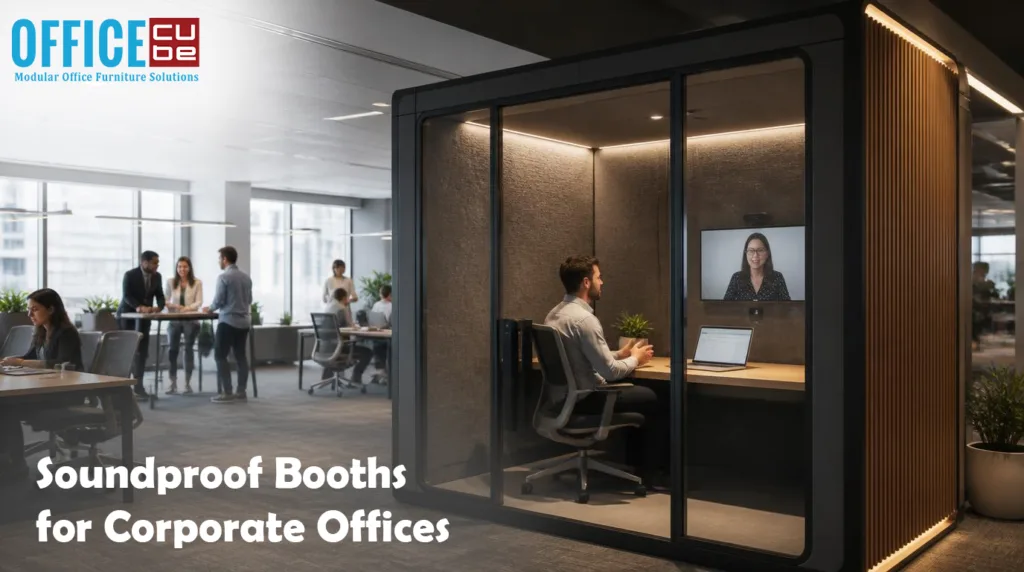
Modern corporate offices are designed to encourage communication, collaboration, flexibility, and movement. Open-plan layouts, shared desks, breakout areas, glass partitions, hot-desking zones, and hybrid workspaces have transformed the traditional workplace. But there is one stubborn problem that keeps following all of these changes: noise.
A colleague joins a video conference three desks away. Someone starts a conversation behind you. A sales representative needs to discuss a client account. An HR manager has to conduct a sensitive employee discussion. Another employee is trying to concentrate on a complex report while several conversations continue nearby. Suddenly, the supposedly flexible workplace feels less like a productive office and more like a busy railway station.
This is where soundproof booths for corporate offices have become increasingly useful. Instead of constructing a permanent room every time an employee needs privacy, companies can introduce compact enclosed spaces designed for phone calls, video meetings, focused work, interviews, confidential conversations, or small-group collaboration.
The concept sounds simple, but choosing the right booth involves more than buying a small enclosed box and putting it somewhere in the office. Acoustic performance, ventilation, lighting, ergonomics, accessibility, electrical requirements, technology, placement, aesthetics, maintenance, and expected usage all matter. A booth that looks impressive but performs poorly acoustically can quickly become an expensive piece of office furniture.
So, what should a company actually look for? How does a soundproof booth differ from an ordinary acoustic pod? Where should it be installed? Is it better than building a conventional meeting room? And how can businesses make sure they are investing in a solution that employees will genuinely use?
This guide explores those questions in detail and explains how soundproof booths can become a practical part of a modern corporate office strategy.
Why Corporate Offices Need Better Acoustic Privacy
The modern workplace has a strange relationship with sound. Employees need to communicate constantly, yet too much communication happening simultaneously can make it difficult for anyone to concentrate. That tension becomes particularly obvious in open-plan offices, where physical boundaries have been reduced in the name of flexibility and collaboration.
Imagine trying to write an important proposal while hearing three different conversations at once. Your brain does not simply switch those voices off because you have decided to concentrate. Human attention naturally reacts to nearby speech, particularly when the conversation is understandable. The result can be a workplace where employees are physically together but mentally scattered.
The issue becomes even more complicated with hybrid work. An office may contain people attending video meetings with colleagues who are working remotely from different cities or countries. Every online meeting creates another potential source of speech, notification sounds, laptop audio, and overlapping conversation. Someone sitting in an open workspace may also feel uncomfortable discussing confidential information because people around them can potentially hear the conversation.
Acoustic privacy is therefore not merely a comfort issue. It can become a workplace functionality issue. Employees need places where they can speak without broadcasting every word to the surrounding office. They also need areas where they can temporarily escape distracting ambient noise when their work requires deep concentration.
Traditional architecture can solve this problem by adding enclosed rooms. However, permanent construction requires planning, floor space, building work, electrical changes, HVAC considerations, and potentially significant expense. It also reduces the flexibility of the office because a room built for one purpose is not always easy to repurpose.
Soundproof booths provide another option. A company can introduce enclosed acoustic spaces without completely redesigning its floor plan. When thoughtfully selected and strategically placed, booths can act like pressure-release valves for a busy workplace: they absorb demand for privacy without requiring every employee to have a permanent private office.
The Hidden Cost of Office Noise
Noise does not always announce itself as a problem. Nobody may file a complaint saying, “The office has exactly 67 distracting conversations today.” Instead, the consequences often appear indirectly. Employees move to stairwells for calls, occupy conference rooms for individual meetings, wear headphones throughout the day, or repeatedly postpone tasks requiring concentration.
That behavior tells an important story.
If employees regularly search for quiet spaces, the office may have a privacy and acoustic design gap. Headphones can reduce the perception of surrounding noise, but they do not create true speech privacy. They also do nothing to prevent an employee’s own conversation from being heard by everyone nearby.
This distinction becomes particularly important for departments handling sensitive information. Human resources, finance, legal, leadership, healthcare-related organizations, financial services companies, and customer support teams may routinely discuss information that should not be overheard casually.
A soundproof booth can give employees an obvious destination when privacy matters. Instead of asking, “Where can I take this call?”, the answer becomes straightforward: use an available booth.
The psychological effect can be useful as well. When employees know that quiet and private spaces are available, they may feel less pressure to compete for conference rooms or improvise workarounds. That can make the office easier to navigate and more predictable.
The goal should not be to eliminate every sound from a corporate environment. A completely silent workplace is neither realistic nor necessarily desirable. The better objective is acoustic choice: giving people the ability to select the appropriate environment for the task they are performing.
What Is a Soundproof Office Booth?
A soundproof office booth is an enclosed workspace engineered to reduce the transfer of sound between the booth and the surrounding environment. Depending on its design, it can be used for private telephone conversations, video conferences, focused work, interviews, one-to-one discussions, or small meetings.
The important word here is engineered. A genuine acoustic booth should not rely solely on decorative foam panels. Effective sound isolation normally requires several elements working together, including dense construction materials, sealed joints, doors or openings designed to minimize sound leakage, acoustic interior surfaces, and appropriate ventilation treatment.
A booth also needs to be comfortable enough for people to stay inside. If the acoustic performance is excellent but the interior becomes stuffy within minutes, employees will avoid using it. The same principle applies to lighting, temperature, seating, desk height, electrical outlets, and technology.
A useful way to think about a quality booth is as a small room-within-a-room. It creates an additional physical barrier between the user and the surrounding office. The precise level of sound reduction varies dramatically by product and installation, which is why companies should avoid treating every product marketed as an “acoustic booth” or “soundproof pod” as equivalent.
A booth may be designed primarily to reduce sound entering the enclosure, sound leaving it, or both. These objectives overlap, but they are not identical. Someone who wants to focus on a report may care primarily about reducing external distractions. An HR professional conducting a confidential conversation may care much more about preventing speech from escaping into the office.
That is why purchasing decisions should begin with a simple question: What acoustic problem are we trying to solve?
If the answer is “employees need somewhere quiet for short calls,” the requirements may be different from those for “employees need confidential conversations that should not be easily overheard.”
Soundproofing vs. Sound Absorption
One of the most important concepts to understand before buying a booth is the difference between soundproofing and sound absorption.
Sound absorption involves materials that reduce reflections inside a space. Soft acoustic panels, felt, fabric, mineral fiber, and similar materials can absorb some sound energy and reduce reverberation. This makes speech clearer and can make a room feel quieter.
Sound isolation, sometimes casually called soundproofing, addresses the movement of sound between spaces. It relies on barriers, mass, airtightness, structural design, and other construction principles.
Think of the difference this way: acoustic absorption is similar to putting cushions inside a room to reduce echoes, while sound isolation is more like building a wall that makes it harder for sound to pass from one side to the other.
A booth can contain excellent acoustic absorption while still providing disappointing privacy if its walls, door seals, ventilation paths, or other components allow significant sound transmission.
For corporate applications, this distinction is crucial. A company should not evaluate a booth solely by how quiet it feels inside. It should also ask how much sound travels through the booth’s enclosure and how the manufacturer has measured that performance.
Key Benefits of Soundproof Booths
The strongest argument for soundproof booths in corporate offices is flexibility. A company does not have to transform the entire workplace to provide employees with more private areas. Instead, booths can be distributed according to actual demand.
That flexibility can support several different workplace activities. Employees may use a single-person booth for a client call in the morning, a remote interview later in the day, and focused work during the afternoon. Larger booths can support small meetings without consuming an entire conference room.
Another benefit is the ability to create privacy without making the office feel permanently divided. Conventional walls create clear boundaries, which can be useful, but too many enclosed rooms can make a workplace rigid. Booths provide enclosed environments while retaining much of the adaptability associated with modern office planning.
They can also help organizations manage conference-room pressure. A common corporate-office problem is the employee who reserves a large meeting room for a 20-minute one-person video call simply because no suitable private space exists. When dedicated booths are available, large rooms can remain available for the meetings that genuinely require them.
The benefit is not simply about square footage. It is about matching space to activity.
A two-person conversation does not necessarily require a twelve-person conference room. A single employee attending a video meeting does not necessarily need an entire enclosed meeting suite. A booth can provide a middle layer between the open desk and the traditional meeting room.
Privacy for Sensitive Conversations
Confidential communication is one of the clearest use cases for acoustic booths. Corporate employees regularly discuss information involving clients, finances, personnel, contracts, strategy, performance, and business operations. Those conversations should take place in environments appropriate to their sensitivity.
Consider an HR manager conducting an employee interview. Holding the conversation at a desk in an open office can create obvious privacy concerns. A conventional meeting room may work, but if all rooms are occupied, the employee may be forced to wait or find another location.
A private booth provides another option.
The same applies to recruiters conducting remote interviews, managers discussing performance matters, legal teams speaking with colleagues, or account managers discussing client information. The booth does not automatically guarantee absolute confidentiality—no acoustic product should be treated as a magical privacy shield—but it can create a significantly more controlled environment than an exposed desk.
Companies should also consider visual privacy. Sound is only one component of confidentiality. A glass-walled booth may provide strong acoustic isolation while allowing people outside to see documents or screens. Frosted glass, privacy film, blinds, appropriate monitor positioning, and interior layout can therefore be just as important for certain applications.
A well-designed booth should be treated as part of a broader privacy strategy rather than as an isolated piece of furniture.
Better Focus and Productivity
Not every booth user will be discussing confidential information. Many simply need somewhere to concentrate.
Some tasks demand sustained attention: financial analysis, coding, writing, strategic planning, data review, design work, and complex decision-making can become harder when interruptions occur continuously. Even a brief interruption may force a person to mentally reconstruct where they were in a task.
A booth offers employees a practical way to change their environment when concentration matters. Instead of trying to overpower surrounding conversations with headphones, they can move into a quieter enclosed area.
This creates an important element of employee choice. One person may work comfortably amid office activity. Another may perform better in a quiet environment. A flexible workplace can accommodate both without forcing the entire organization to follow one working style.
The booth therefore works best as one part of a varied acoustic landscape. Open collaboration areas, standard desks, quiet zones, meeting rooms, lounges, and acoustic booths can coexist. The objective is not to turn every employee into an isolated worker; it is to give employees an appropriate environment for different types of work.
Types of Soundproof Booths for Offices
There is no single type of office soundproof booth suitable for every corporate environment. Booths vary considerably in size, acoustic performance, configuration, technology, mobility, and intended use.
The most common category is the single-person phone booth. These compact units are designed for short calls, video conferences, and individual concentration. Their small footprint makes them particularly attractive in offices where floor space is limited.
Next are two-person or small meeting booths. These provide more room for face-to-face conversations and collaborative discussions. They can be useful for managers, recruiters, sales teams, and project groups that need occasional privacy without requiring a traditional conference room.
Larger executive or multi-person booths sit further along the spectrum. These can function almost like compact meeting rooms and may accommodate several employees. Because they occupy more space, companies should evaluate whether the demand justifies the footprint.
The right mix depends on actual usage. An office with hundreds of employees attending individual video calls may benefit from numerous single-person units. A consultancy where small client meetings dominate may need more two- or four-person spaces.
Single-Person Phone Booths
Single-person booths are often the easiest way to introduce acoustic privacy into an existing office. They typically occupy relatively little floor area and can be positioned near workstations, collaboration zones, or circulation areas without requiring an architectural renovation.
Their primary purpose is usually phone and video communication. A good booth should provide enough desk space for a laptop, comfortable seating or standing capability, appropriate lighting, electrical connectivity, and ventilation. Since users may be speaking continuously during calls, airflow is especially important.
Ergonomics also deserve attention. If the booth is designed only for short calls, a compact stool may be acceptable. If employees are expected to remain inside for extended periods, the seating, desk height, posture support, and internal dimensions become much more important.
The booth should also accommodate modern communication equipment. Employees may need space for laptops, headsets, cameras, charging devices, and other accessories. Poor cable management can quickly turn a clean booth into a cramped workspace.
A company should also examine accessibility requirements rather than assuming that every compact booth will work for every employee. Door width, internal maneuvering space, threshold design, controls, seating, and overall dimensions should be reviewed against applicable local standards and the needs of the workforce.
Meeting and Collaboration Booths
Two-person and multi-person booths serve a different purpose. They provide a controlled environment for conversations where employees need to interact directly rather than simply make individual calls.
These booths can be particularly useful in hybrid organizations. Imagine two employees working together in an office while another colleague joins through video conference. An open desk can create background noise and distractions, while a large conference room may be unnecessarily spacious. A small collaboration booth can provide an appropriately scaled setting.
The interior arrangement matters. Face-to-face seating can support discussion, while a table and screen can facilitate presentations or remote collaboration. Acoustic treatment should account for multiple speakers because several voices can create more internal reverberation than a single-person call.
Technology integration is also increasingly important. A booth may include power outlets, USB charging, display connectivity, cameras, microphones, speakers, and occupancy indicators. The technology should remain intuitive. If employees need a five-minute tutorial just to start a video call, the booth will quickly become frustrating.
Executive and Multi-Person Booths
Larger booths can function as compact meeting rooms for teams that need privacy but do not require a conventional enclosed office. Their greater size allows for more comfortable seating, larger tables, screens, and collaborative equipment.
However, size introduces new considerations. A larger booth may require more ventilation capacity, more electrical infrastructure, more sophisticated acoustic construction, and a stronger installation plan. It may also become a more permanent part of the office layout.
For this reason, companies should avoid selecting larger booths simply because they appear more versatile. Versatility is valuable only when the space will actually be used.
A practical approach is to analyze workplace behavior first. If employees repeatedly search for one-person privacy, prioritize phone booths. If teams consistently struggle to find spaces for two- or three-person meetings, introduce collaboration booths. If confidential management conversations are frequent, larger private spaces may make sense.
The booth mix should follow the work patterns of the organization, not the other way around.
Features to Look for When Choosing a Booth
A soundproof office booth can look excellent in a showroom and still disappoint employees in daily use. The difference often comes down to details that are easy to overlook during the initial purchase.
Start with documented acoustic performance. Ask manufacturers how their products have been tested, under what conditions, and what the measurements actually represent. Marketing phrases such as “soundproof,” “noise-free,” or “maximum privacy” are less useful than transparent technical information.
Next, examine the door. A poorly sealed door can undermine an otherwise sophisticated enclosure. Gaps, lightweight construction, or inadequate seals can become acoustic weak points.
Ventilation deserves equal attention. An enclosed booth needs continuous air exchange, especially when occupied for extended periods. Fans and airflow systems should ideally be designed to maintain comfort without becoming a new source of distracting noise.
Lighting is another frequently underestimated feature. Video calls require appropriate illumination, while focused work requires comfortable, glare-controlled lighting. Adjustable lighting can be particularly useful because different users have different preferences.
Power and connectivity should be easy to access. Employees should not have to crawl underneath furniture to charge a laptop.
Interior materials should be durable and easy to clean, particularly in shared corporate environments. Fabrics and surfaces should withstand repeated use without quickly appearing worn.
Acoustic Performance, Ventilation, and Lighting
These three elements deserve special attention because they interact with one another.
Acoustic treatment can make the booth quieter internally, but ventilation equipment can introduce mechanical noise. A fan that sounds insignificant in an open office may become surprisingly noticeable inside a small enclosed space. Manufacturers should therefore explain both airflow performance and acoustic characteristics.
Lighting has a similar relationship with usability. A booth that is acoustically excellent but visually uncomfortable may be avoided. Harsh overhead lighting, screen glare, insufficient illumination, or excessive heat can make a user leave quickly.
The best booth design treats acoustics, air, light, ergonomics, and technology as one system.
Companies should also think about cleaning. A shared booth may be used dozens of times by different people. Frequently touched surfaces, handles, desks, switches, and seating materials should be straightforward to maintain. If cleaning requires complicated procedures, real-world hygiene can suffer.
Warranty and replacement support matter too. A booth is a workplace asset, not merely a decorative object. Companies should understand what happens if a fan fails, a door seal wears out, lighting stops working, or a component becomes damaged.
How Soundproof Booths Improve Hybrid Work
Hybrid work has changed the acoustic demands placed on corporate offices. A person physically sitting in an office may spend a substantial part of the day communicating with people who are somewhere else.
That means the office has effectively become a collection of miniature broadcasting stations. Every laptop can produce a meeting, every employee can become a speaker, and every open workspace can become part of someone else’s background.
Soundproof booths provide a way to contain those interactions.
An employee can enter a booth, join a video meeting, speak naturally, and leave without turning the surrounding workspace into part of the conversation. Remote participants also benefit because reduced background noise can make voices easier to understand.
The benefit goes in the other direction too. A person sitting outside the booth is less likely to hear the meeting taking place inside it. This can reduce the acoustic competition that occurs when multiple virtual meetings happen simultaneously.
For hybrid organizations, booths can therefore support meeting equity. Employees joining remotely need to hear the conversation clearly, while employees in the office need an environment where several simultaneous meetings do not become overwhelming.
There is also a social consideration. Without suitable private spaces, employees may feel pressure to whisper during confidential calls or avoid speaking freely. A properly designed booth gives them a designated place where normal conversation is appropriate.
That can make hybrid communication feel more natural.
Where to Place Soundproof Booths in a Corporate Office
Placement can determine whether a booth becomes a heavily used workplace resource or an attractive piece of furniture that employees ignore.
The first principle is visibility and convenience. If employees have to walk through several departments to find a booth, they may simply stay at their desks. A booth should be easy to locate without becoming an obstacle in a major circulation path.
Near high-traffic areas can be useful because demand is often highest around collaborative zones. However, placing booths directly beside noisy equipment, printers, cafeterias, elevators, or heavily trafficked doors can undermine their purpose.
Companies should also consider privacy from a visual perspective. A booth with transparent walls positioned in a busy corridor may technically enclose a person while still making them feel exposed.
A good office plan often distributes booths across different zones rather than concentrating all of them in one corner. Employees working in different departments can then access privacy without unnecessary travel.
Placement Mistakes to Avoid
One common mistake is putting a booth next to the loudest equipment in the building. If the external noise source is persistent, the booth’s acoustic performance may not deliver the expected user experience.
Another mistake is blocking circulation. Office furniture should support movement, not create bottlenecks. Fire safety, emergency access, accessibility, and local building requirements should be reviewed before installation.
Companies should also avoid hiding booths in undesirable spaces simply because those spaces are available. Employees notice environmental quality. If a booth is positioned beside a storage area or in an uncomfortable corner, usage may remain low.
Finally, do not assume that one booth automatically solves a building-wide privacy problem. A single unit serving a large workforce can quickly become overbooked. Usage data, employee feedback, and occupancy patterns should guide future expansion.
Soundproof Booths vs. Traditional Meeting Rooms
A soundproof booth and a traditional meeting room solve related but different problems.
A conventional meeting room offers more space and greater flexibility for larger groups. It can accommodate presentations, workshops, extended meetings, and activities requiring substantial equipment. It may also provide stronger architectural separation depending on its construction.
A booth, by comparison, is optimized for short-duration, space-efficient privacy.
The difference becomes obvious when considering a typical office day. Reserving a large conference room for one employee’s 20-minute video call is inefficient if several teams need the room for collaborative meetings. A phone booth can absorb that individual demand and preserve the larger room for activities that genuinely need it.
| Feature | Soundproof Booth | Traditional Meeting Room |
| Space requirement | Generally compact | Usually larger |
| Individual calls | Highly suitable | Often inefficient |
| Small meetings | Suitable depending on size | Suitable |
| Large meetings | Limited | Highly suitable |
| Installation flexibility | Often higher | Usually lower |
| Privacy | Designed for acoustic enclosure | Depends on wall and door construction |
| Long meetings | Depends on booth design | Generally more comfortable |
| Reconfiguration | Often easier | Usually more difficult |
This does not mean booths should replace meeting rooms. A well-planned corporate office often needs both.
The better question is: Which activities belong in which spaces?
When each type of space has a clear purpose, employees spend less time searching for an appropriate location. The meeting room becomes a resource for groups, while booths handle individual calls, confidential discussions, and short focused sessions.
Materials Used in Acoustic Office Booths
The construction materials inside and around a booth influence both acoustic performance and everyday usability.
Manufacturers may combine materials such as laminated panels, acoustic fabrics, mineral-based insulation, PET felt, glass, rubber seals, engineered wood, metal framing, and other specialized components. The precise combination varies by manufacturer and product category.
Dense exterior surfaces can contribute to sound isolation, while porous interior materials can help control reflections. This combination matters because a booth needs to prevent sound transmission while also maintaining comfortable internal acoustics.
Glass deserves particular attention. Transparent surfaces can create a bright, modern appearance and help employees feel connected to the office. But the type, thickness, framing, and sealing of glass affect acoustic performance. A poorly integrated glass panel can become a weak point in an otherwise well-engineered enclosure.
Interior fabrics also have practical considerations. They should be durable and cleanable, particularly in workplaces where many employees share the same booth.
Sustainability is another factor worth investigating. Companies increasingly ask whether booth materials contain recycled content, whether components can be replaced individually, and whether the product can be disassembled or reused when an office relocates.
The best material choice is therefore not simply the one with the most impressive specification sheet. It is the one that balances acoustic performance, durability, safety, appearance, maintenance, and environmental considerations.
How Much Do Soundproof Office Booths Cost?
The cost of a soundproof office booth can vary significantly. There is no meaningful universal price because products differ in size, acoustic specification, materials, ventilation, technology, furniture, customization, shipping, installation, and regional availability.
A basic single-person booth may be considerably less expensive than a large multi-person meeting pod equipped with integrated audiovisual technology. Similarly, a premium architectural booth can cost much more than a lightweight acoustic privacy enclosure.
Rather than comparing prices alone, companies should calculate the total cost of ownership.
That may include the booth itself, delivery, assembly, electrical work, floor preparation, technology, maintenance, replacement components, and future relocation. If a booth requires specialized installation or modifications to the office, those expenses should be included in the purchasing evaluation.
Factors That Influence Booth Pricing
Size is usually one of the most obvious cost drivers. Larger booths require more materials and typically involve more complex ventilation and structural requirements.
Acoustic specification also matters. A product designed primarily to reduce reverberation is not equivalent to a highly isolated enclosure intended for private conversations.
Technology can increase the price as well. Integrated displays, microphones, cameras, occupancy systems, automated lighting, charging systems, and smart controls can transform a basic booth into a technology-enabled meeting environment.
Customization has another effect. Corporate branding, special finishes, unusual dimensions, accessibility modifications, and bespoke layouts may increase manufacturing and installation costs.
Companies should therefore avoid choosing a booth solely because it has the lowest initial price. A cheaper product that employees dislike, avoid, or cannot comfortably use may provide poor value. Conversely, a premium booth may not be justified if the organization only needs a basic space for occasional phone calls.
The sensible approach is to define the use case first and then compare products against that requirement.
Installation, Maintenance, and Long-Term Use
Installing a soundproof booth is generally more straightforward than constructing a conventional room, but it still requires planning.
The company should confirm the floor loading, dimensions, delivery route, electrical supply, ventilation requirements, and accessibility before ordering. Large booths may require careful coordination with elevators, doors, corridors, and building management.
Electrical connections should be installed safely and in accordance with applicable local requirements. If the booth includes technology, additional network or audiovisual planning may be necessary.
Maintenance should be considered before purchase rather than after something breaks. Ask whether fans, lights, door seals, panels, and electrical components can be replaced individually. Modular components can be particularly valuable for companies that expect to relocate or reconfigure their office.
Cleaning procedures should also be simple. Shared booths benefit from surfaces that can withstand regular cleaning without degrading rapidly.
Employee behavior matters too. A booth should have clear but unobtrusive guidance regarding maximum occupancy, ventilation, food, cleanliness, and booking if reservations are required.
The long-term success of a booth depends less on its novelty and more on whether it becomes part of the normal rhythm of work.
Are Soundproof Booths Suitable for Small Offices?
Small offices can benefit significantly from acoustic booths because every square meter matters.
A small company may not have enough space or budget for multiple permanent meeting rooms. Yet employees still need somewhere to take private calls, interview candidates, meet clients remotely, or concentrate without interruption.
A compact booth can introduce a dedicated private zone without consuming as much floor area as a conventional room.
However, small offices need to be especially careful about proportion. A booth should not consume so much space that it makes the remaining workplace uncomfortable. Circulation, desks, storage, emergency access, and shared areas still need to function properly.
A single-person booth may be enough for a small team, particularly if most work is collaborative and employees only occasionally need privacy. A larger booth could make sense if the company regularly holds small confidential meetings.
Usage is the deciding factor.
Before purchasing, managers can ask employees how often they need private spaces, what activities they perform there, how long they typically stay, and whether existing rooms are frequently unavailable. Those answers can reveal whether a booth is likely to solve a real problem.
Designing a Booth Strategy for Large Corporate Workplaces
Large offices need a more systematic approach. Installing booths randomly can produce uneven access, congestion, and underused areas.
A better strategy begins with workplace data. Organizations can examine meeting-room bookings, employee surveys, occupancy patterns, department requirements, and common complaints about noise or privacy.
Different departments may have very different needs. A sales team may require many individual video-call spaces. HR may need private interview areas. Executives may require confidential conversations. Product teams may need small collaborative spaces.
The solution can therefore be a portfolio of booth types rather than a standardized installation everywhere.
Large companies should also consider booking systems. Single-person booths used for short calls may work well as first-come, first-served spaces. Larger booths may benefit from reservations.
However, excessive booking requirements can create unnecessary friction. If employees need a private booth for a spontaneous five-minute call, a complicated reservation system defeats part of the purpose.
The goal is to make privacy easy to access without allowing a small number of employees to monopolize shared resources.
Sustainability and Energy Efficiency Considerations
Sustainability should be part of the booth conversation from the beginning.
A booth’s environmental impact involves its materials, manufacturing process, transportation, energy consumption, lifespan, repairability, and end-of-life disposal. Companies should ask manufacturers whether individual components can be repaired or replaced rather than requiring complete product replacement.
Energy use also matters. Ventilation systems and lighting may operate for long periods in busy offices. Efficient fans, occupancy sensors, LED lighting, and sensible control systems can reduce unnecessary energy consumption.
Longevity is another form of sustainability. A booth that lasts many years and can be relocated between offices may provide greater resource efficiency than a product that must be discarded whenever a company changes its floor plan.
Modular design can be particularly useful. If panels, doors, lighting systems, and ventilation components can be replaced separately, maintenance becomes easier and the useful life of the overall product can increase.
Companies should look beyond marketing claims and request specific information about materials, certifications, energy use, repairability, and warranties.
Common Mistakes When Buying Office Soundproof Booths
One of the biggest mistakes is assuming that every product labeled a soundproof booth provides the same acoustic performance. It does not. Companies should investigate independent or manufacturer-provided test information and understand exactly what was measured.
Another mistake is focusing entirely on external noise while ignoring internal comfort. A booth can reduce outside distractions yet still feel unpleasant if it has poor airflow, uncomfortable seating, inadequate lighting, or excessive fan noise.
Some companies also underestimate demand. One booth may look sufficient during planning but become permanently occupied after installation. Employee behavior should be considered when determining quantity.
Ignoring visual privacy can create another problem. If confidential conversations are visible through transparent walls, users may still feel exposed.
Placement mistakes are equally common. A technically excellent booth positioned beside a noisy printer or in a major pedestrian route may perform poorly in practice.
Finally, companies sometimes purchase booths without considering future office changes. A modular product that can be dismantled and moved may provide greater long-term flexibility than a solution designed for one permanent location.
How to Evaluate Acoustic Performance Before Buying
Acoustic performance should be evaluated using evidence rather than appearance.
Ask the manufacturer for technical documentation describing how the booth was tested. Look for information about sound transmission, acoustic isolation, reverberation, ventilation noise, and test conditions. Be cautious about comparing numbers from different testing methods as if they were directly interchangeable.
A practical demonstration can also help. If possible, visit a showroom or an existing installation and test the booth from both sides. Have someone speak inside at a normal conversational volume while another person stands outside. This is not a substitute for laboratory testing, but it can reveal obvious weaknesses.
Test the booth during realistic activities rather than simply standing silently inside it. Try a phone call, video meeting, conversation, and several minutes of focused work.
Listen to the ventilation system. Check whether the door closes firmly. Look for visible gaps. Examine whether voices outside remain distracting.
The purchasing team should also ask about installation. Acoustic performance can be affected by how a booth interacts with the surrounding floor, walls, ceiling, and building environment.
In other words, the product and the installation are part of the same acoustic system.
The Future of Soundproof Booths in Corporate Workspaces
The role of acoustic booths is likely to evolve alongside the workplace itself. As organizations continue combining office-based work with remote communication, the demand for spaces designed specifically for individual digital interaction can remain significant.
Future booths may incorporate more intelligent occupancy management, improved ventilation controls, adaptive lighting, integrated conferencing systems, and workplace analytics. Some may connect with room-booking platforms or automatically indicate whether a space is occupied.
Yet technology should remain secondary to the fundamentals. A booth with sophisticated sensors is not useful if employees cannot sit comfortably inside it. A booth with a high-end camera is not solving the core problem if conversations can still be easily heard outside.
The most effective designs will likely be those that combine acoustic privacy, human comfort, flexibility, and simple technology.
Corporate offices are also becoming more varied. Some organizations want highly collaborative environments, while others require quiet concentration zones. Some teams are office-centric, while others work almost entirely through digital communication.
That means the future office is unlikely to have one universal acoustic formula.
Instead, successful workplaces may increasingly offer a range of environments and let employees select the space that matches the task at hand. A booth becomes one tool in that larger toolkit—a compact room for moments when privacy, concentration, or clear communication matters.
Conclusion
Soundproof booths for corporate offices offer a practical way to address one of the most persistent challenges of modern workplace design: balancing collaboration with privacy and concentration.
Their value comes from flexibility. A well-designed booth can give an employee somewhere to make a confidential call, conduct a video meeting, focus on demanding work, or hold a small discussion without consuming a full-size conference room.
But the word “soundproof” should not be treated as a guarantee by itself. Companies should investigate documented acoustic performance, door sealing, ventilation noise, internal acoustics, lighting, ergonomics, accessibility, technology, maintenance, and installation requirements before making a purchase.
The right booth is also the right booth for a specific use case. A compact phone booth may be ideal for individual calls, while a larger collaboration pod may better suit small meetings. A company with a large workforce may need several booth types distributed across different zones rather than one standardized product.
Perhaps the most useful way to think about these spaces is as acoustic choice. Modern employees do not perform every task in the same environment. Sometimes they need conversation and collaboration. Sometimes they need silence. Sometimes they need privacy. Sometimes they need a place where a remote colleague can join a meeting without competing with twenty other conversations.
A thoughtfully planned booth strategy gives employees those choices.
When acoustic performance, comfort, placement, and workplace behavior are considered together, soundproof booths can become much more than trendy office furniture. They can become a practical layer of corporate workplace infrastructure—small, flexible spaces that help a busy office work more smoothly.
FAQs About Soundproof Booths for Corporate Offices
1. Are soundproof office booths completely silent inside?
No. A well-designed booth is intended to reduce sound transmission and improve acoustic privacy, but it should not be assumed to create absolute silence. Internal ventilation, equipment, and some external sounds may still be audible. The actual level of isolation depends on the booth’s construction, seals, ventilation system, installation, and surrounding environment.
2. Can employees use soundproof booths for video conferences?
Yes. Video conferencing is one of the most common applications for office booths. A suitable booth can provide a quieter background for the employee and reduce the amount of their conversation heard by people working nearby. Companies should make sure the booth has adequate lighting, ventilation, power, desk space, and connectivity for the intended conferencing equipment.
3. How many soundproof booths does a corporate office need?
There is no universal number. The appropriate quantity depends on employee headcount, hybrid-work patterns, call frequency, meeting-room availability, and how often employees need private spaces. Companies can examine room-booking data and conduct employee surveys to estimate demand before purchasing multiple units.
4. Are soundproof booths better than meeting rooms?
They serve different purposes. Booths are generally designed for compact, individual, or small-group activities, while traditional meeting rooms offer greater capacity and flexibility for larger groups. Using booths for individual calls can also help preserve larger meeting rooms for activities that genuinely require more space.
5. What should companies check before buying a soundproof office booth?
Companies should review documented acoustic testing, dimensions, door seals, ventilation and fan noise, lighting, ergonomics, accessibility, electrical requirements, technology compatibility, cleaning, warranty, installation, and maintenance. It is also useful to test a booth in person when possible and evaluate it under realistic working conditions rather than judging it solely by appearance.