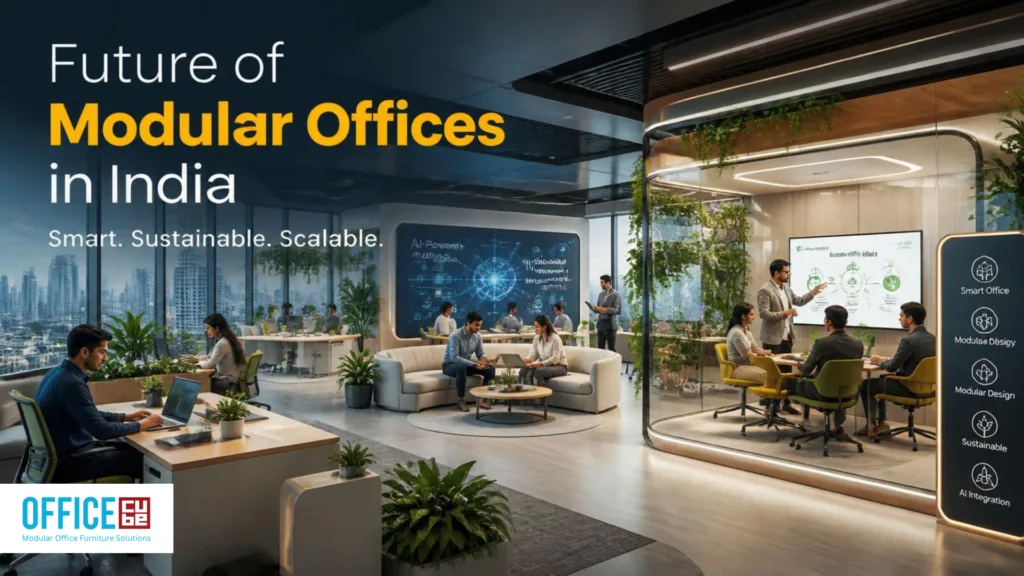
The Indian workplace is undergoing one of the biggest transformations in its history. Traditional office layouts filled with fixed cabins, permanent walls, and rigid furniture arrangements are gradually making way for dynamic, adaptable, and technology-driven environments. At the center of this transformation lies the concept of modular offices. These workspaces are designed to be flexible, scalable, and capable of evolving with changing business needs. As companies continue to embrace hybrid work models, employee well-being initiatives, and cost optimization strategies, modular office solutions are emerging as the preferred choice for startups, SMEs, multinational corporations, and coworking operators alike.
India’s commercial real estate sector is showing remarkable resilience. Industry reports indicate that office leasing activity is expected to reach between 85 and 90 million square feet by FY 2026-27, driven by Global Capability Centers (GCCs) and the increasing adoption of flexible workspaces. This growth reflects a strong demand for modern workplace solutions that can adapt quickly to business requirements. As organizations seek greater workplace agility, modular office systems are becoming an essential component of future-ready work environments. The future of modular offices in India is not simply about furniture or partitions; it is about creating smarter ecosystems that support productivity, collaboration, innovation, and sustainable growth.
Understanding the Rise of Modular Offices
What Are Modular Offices?
A modular office is a workspace built using flexible components that can be easily assembled, disassembled, expanded, or reconfigured according to changing organizational requirements. Unlike traditional office construction, modular offices utilize movable partitions, modular workstations, acoustic pods, collaborative zones, height-adjustable desks, and adaptable furniture systems. This approach allows businesses to redesign their workspace without undergoing extensive renovations or disrupting operations.
Think of modular offices as building blocks similar to LEGO pieces. Companies can add, remove, or rearrange elements whenever their teams grow, shrink, or change work patterns. This flexibility has become increasingly valuable in today’s business environment, where uncertainty and rapid change have become normal. Organizations no longer want to invest heavily in office structures that may become obsolete within a few years. Instead, they seek environments that can evolve alongside their business strategies. This shift is fueling demand for modular office furniture, smart partitions, collaborative hubs, and technology-enabled workspace solutions across India.
Why Indian Businesses Are Adopting Modular Workspaces
The popularity of modular offices in India is largely driven by changing workforce expectations and evolving business models. Employees now expect workplaces that support collaboration, creativity, wellness, and flexibility. Traditional office designs often struggle to meet these expectations. Modular environments, on the other hand, provide businesses with the ability to continuously optimize workplace experiences without major investments.
Another major factor is cost efficiency. Companies are increasingly looking for solutions that reduce long-term operational expenses while maximizing space utilization. Modular office systems enable organizations to scale their workspace according to demand, reducing waste and improving occupancy rates. Businesses operating in sectors such as IT, fintech, consulting, healthcare, education, and manufacturing are particularly attracted to the flexibility offered by modular designs. As workplace strategies continue to evolve, modular offices are becoming less of a trend and more of a strategic business necessity.
Current State of India’s Modular Office Market
Market Growth and Industry Statistics
India’s modular furniture and office solutions market is witnessing strong growth. Industry estimates suggest that the Indian modular furniture market reached approximately USD 4 billion in 2025 and is projected to grow to USD 7.7 billion by 2034, reflecting sustained demand for adaptable workspace solutions. At the same time, the broader office furniture market is expected to grow from USD 6.26 billion in 2025 to over USD 14 billion by 2034.
| Market Segment | 2025 Value | Future Projection |
| Modular Furniture Market | USD 4 Billion | USD 7.7 Billion by 2034 |
| Office Furniture Market | USD 6.26 Billion | USD 14.12 Billion by 2034 |
| Flexible Workspace Supply | 80 Million Sq. Ft. | 125 Million Sq. Ft. by 2027 |
These numbers highlight a clear trend: businesses are investing heavily in flexible workplace infrastructure. The growth of coworking spaces, managed offices, and hybrid workplace strategies is creating unprecedented demand for modular office solutions.
Key Industries Driving Demand
Several sectors are accelerating the adoption of modular offices across India. Information Technology remains the largest contributor due to continuous expansion and workforce scaling requirements. Global Capability Centers are also driving significant demand as multinational corporations establish large operations across major Indian cities. Reports indicate that GCCs could contribute nearly half of India’s flexible workspace demand by 2027.
Healthcare, education, engineering, manufacturing, and professional services firms are also embracing modular office concepts. These industries require adaptable spaces that can accommodate evolving team structures, technological upgrades, and changing operational workflows. The ability to reconfigure offices without major construction makes modular solutions highly attractive across diverse sectors.
Major Trends Shaping the Future of Modular Offices
Hybrid Work Culture
Hybrid work has fundamentally changed workplace design. Employees no longer occupy the office five days a week, which means companies need more versatile and efficient spaces. Instead of assigning fixed desks to every employee, organizations are creating shared workstations, collaboration zones, meeting pods, and flexible seating arrangements.
Modular offices align perfectly with this trend. They allow businesses to adjust layouts based on occupancy levels and employee preferences. Teams can easily transform a workspace from a collaborative hub into a focused work environment within hours rather than weeks. This adaptability helps organizations optimize real estate investments while maintaining employee satisfaction and productivity.
Smart Office Technology Integration
Technology is becoming deeply embedded within modular office environments. Future workplaces will feature IoT-enabled desks, occupancy sensors, automated lighting systems, smart meeting rooms, and AI-powered space management platforms. These technologies will provide real-time insights into how spaces are being used, enabling organizations to make data-driven decisions about workplace optimization.
Smart modular offices will also improve employee experiences by personalizing workspace settings. Imagine arriving at work and having your preferred desk height, lighting level, and temperature automatically adjusted. These innovations will become increasingly common as businesses prioritize workplace efficiency and employee well-being.
Sustainable and Green Workspaces
Sustainability is no longer optional for modern businesses. Organizations are under increasing pressure to reduce environmental impact and meet ESG goals. Modular office systems support sustainability by minimizing construction waste, extending product lifecycles, and enabling reuse of materials.
Companies are increasingly investing in eco-friendly furniture made from recycled materials, low-emission manufacturing processes, and energy-efficient workplace technologies. Industry experts believe sustainable modular solutions will become a major competitive differentiator over the next decade.
Flexible Space Planning
The office of the future will prioritize adaptability over permanence. Organizations want spaces that can accommodate rapid changes in workforce size, project requirements, and operational priorities. Modular planning enables businesses to create dynamic environments that support both individual productivity and collaborative innovation.
Flexible layouts also help organizations respond quickly to market opportunities. Whether launching a new department, expanding a team, or creating innovation hubs, modular office systems provide unmatched agility compared to traditional workplace designs.
Role of Modular Furniture in Future Workspaces
Ergonomics and Employee Well-Being
Employee well-being has become a critical factor in workplace design. Businesses increasingly recognize that comfortable employees are more productive, engaged, and satisfied. Modular furniture solutions support ergonomic workplace strategies through height-adjustable desks, ergonomic seating, collaborative lounges, and wellness-focused environments.
Research consistently shows that workplace comfort influences employee performance. Organizations investing in ergonomic modular furniture are not simply improving aesthetics; they are enhancing productivity, reducing absenteeism, and strengthening talent retention. Future offices will continue to prioritize human-centric design principles that support physical and mental well-being.
Multi-Functional Furniture Systems
The future workplace demands versatility. A conference room today may need to become a training space tomorrow and a brainstorming zone next week. Modular furniture systems make this possible through movable tables, foldable workstations, mobile storage units, and adaptable seating solutions.
These systems maximize space efficiency while supporting diverse workplace activities. Instead of dedicating separate areas for every function, organizations can create multipurpose environments that evolve according to business needs. This flexibility is especially valuable in urban markets where office space comes at a premium.
Growth of Flexible and Managed Offices in India
Rise of Coworking Spaces
India’s flexible workspace sector is experiencing extraordinary growth. Industry reports indicate that flexible office supply could reach 125 million square feet by 2027, growing at a CAGR of approximately 21-22%. Flexible workspace operators recorded a record 12.4 million square feet of leasing activity in 2024, representing significant year-on-year growth.
This expansion is driving demand for modular office infrastructure. Coworking operators require environments that can accommodate freelancers, startups, SMEs, and large enterprises simultaneously. Modular solutions provide the flexibility needed to serve diverse customer requirements while maximizing occupancy and profitability.
Corporate Adoption of Flexible Offices
One of the most significant developments in India’s workspace market is the growing adoption of flexible offices by large corporations. Reports show that enterprises accounted for approximately 72% of flexible workspace seat absorption in major Indian cities during 2025.
This shift demonstrates that flexible workspaces are no longer viewed as temporary solutions. Large organizations increasingly consider them a core component of long-term real estate strategies. As enterprise demand grows, modular office solutions will play an even more important role in creating scalable and efficient workplace environments.
Opportunities for Businesses and Developers
Cost Efficiency and Scalability
Modular offices offer significant financial advantages compared to traditional office construction. Businesses can expand or modify workspaces without undertaking expensive renovations, reducing both capital expenditure and operational disruption. This scalability makes modular solutions particularly attractive for high-growth companies and organizations operating in rapidly changing markets.
Developers also benefit from modular concepts by creating flexible commercial properties that appeal to a wider range of tenants. As demand for adaptable workplaces increases, buildings designed around modular principles are likely to achieve higher occupancy rates and stronger long-term value.
Expansion into Tier-2 and Tier-3 Cities
India’s economic growth is increasingly extending beyond major metropolitan areas. Cities such as Ahmedabad, Indore, Coimbatore, Kochi, Jaipur, Lucknow, and Visakhapatnam are emerging as attractive business destinations. Companies expanding into these markets often seek cost-effective and scalable workspace solutions.
Modular offices provide an ideal framework for supporting this expansion. Businesses can establish professional work environments quickly while maintaining flexibility for future growth. This trend is expected to create significant opportunities for modular furniture manufacturers, office designers, and workspace solution providers across India.
Challenges Facing Modular Office Adoption
Cost Perception and Awareness
Despite their long-term benefits, modular office solutions are sometimes perceived as expensive compared to conventional alternatives. Many organizations focus on initial investment costs rather than lifecycle value, which can slow adoption. Increasing awareness about long-term savings, flexibility, and productivity benefits will be essential for accelerating market growth.
Education and demonstration projects can help businesses better understand the financial and operational advantages of modular workspaces. As success stories become more visible, resistance to adoption is likely to decrease.
Customization and Design Complexity
While modular systems offer remarkable flexibility, designing effective modular environments requires expertise. Organizations must carefully balance functionality, aesthetics, technology integration, and employee experience. Poorly designed modular spaces can undermine productivity and fail to deliver expected benefits.
This challenge creates opportunities for specialized workplace consultants, architects, and furniture manufacturers capable of delivering tailored solutions. As the market matures, professional design services will become increasingly important.
What the Future Looks Like by 2030
AI-Powered Workspaces
Artificial intelligence will transform how modular offices operate. AI systems will analyze occupancy patterns, optimize energy usage, recommend layout changes, and enhance workplace experiences. Smart offices will continuously adapt to employee behaviors and business requirements, creating highly efficient environments.
Organizations will increasingly rely on AI-driven insights to make workplace decisions. This shift will strengthen the value proposition of modular office systems, which are inherently designed for adaptability and continuous improvement.
Data-Driven Workplace Design
The future workplace will be guided by data rather than assumptions. Sensors, analytics platforms, and workplace management tools will provide detailed insights into how employees interact with office environments. Businesses will use this information to refine layouts, improve collaboration, and maximize space utilization.
Data-driven design will enable organizations to create workplaces that evolve continuously rather than undergoing major redesigns every few years. Modular office systems will provide the physical flexibility needed to implement these ongoing improvements efficiently.
Conclusion
The future of modular offices in India is exceptionally promising. Driven by hybrid work models, technological innovation, sustainability goals, and the rapid growth of flexible workspaces, modular office solutions are becoming a cornerstone of modern workplace strategy. India’s commercial real estate market continues to expand, while enterprises increasingly demand agile environments capable of adapting to changing business needs. As flexible workspace supply grows, modular furniture adoption rises, and smart office technologies mature, modular offices will play a critical role in shaping the workplaces of tomorrow.
Organizations that invest in modular office concepts today are positioning themselves for long-term success. They gain the ability to respond quickly to market changes, improve employee experiences, optimize operational costs, and support sustainable growth. By 2030, modular offices are likely to become the standard rather than the exception across India’s evolving business landscape.
FAQs
1. What is a modular office?
A modular office is a flexible workspace built using adaptable components such as movable partitions, modular furniture, and reconfigurable layouts that can be easily modified according to business needs.
2. Why are modular offices becoming popular in India?
They offer flexibility, scalability, cost efficiency, and support for hybrid work models, making them ideal for modern businesses.
3. How does modular furniture improve workplace productivity?
Modular furniture enhances ergonomics, supports collaboration, improves space utilization, and creates comfortable work environments that boost employee performance.
4. Which industries are adopting modular offices the fastest?
IT, Global Capability Centers, coworking operators, consulting firms, healthcare organizations, educational institutions, and manufacturing companies are among the leading adopters.
5. What will modular offices look like in 2030?
Future modular offices will feature AI-powered workplace management, smart furniture, sustainable materials, advanced analytics, and highly adaptable layouts designed around employee experiences.