
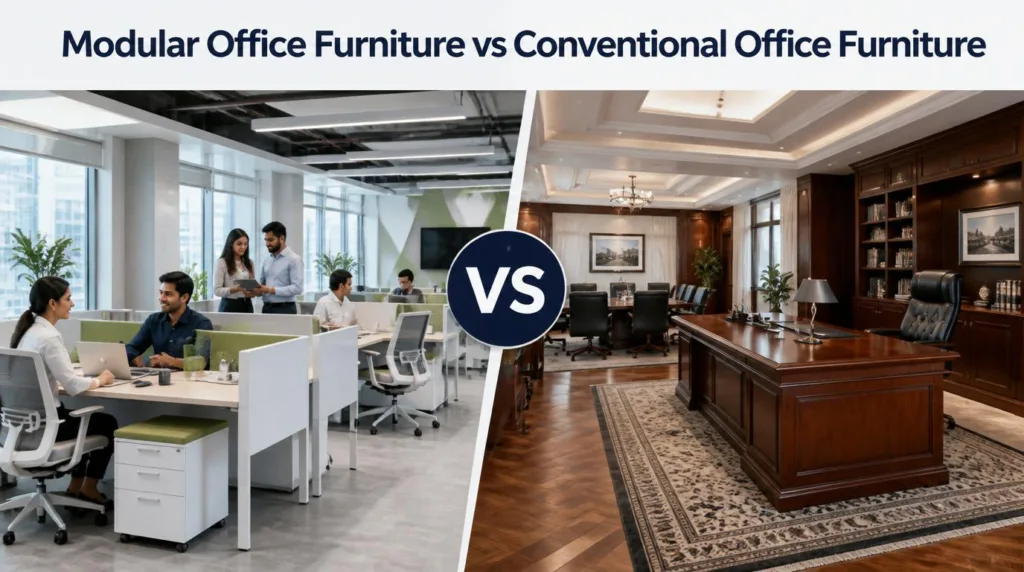
The modern workplace has changed dramatically over the last decade. Open-plan offices, hybrid work models, collaborative environments, and rapidly growing businesses have transformed the way companies think about office design. Furniture is no longer viewed as a simple workplace necessity. It has become a strategic investment that influences productivity, employee satisfaction, brand image, and operational efficiency. One of the most common decisions businesses face today is whether to invest in modular office furniture or conventional office furniture.
At first glance, the choice may appear straightforward. One option offers flexibility and adaptability, while the other emphasizes durability and tradition. However, the reality is far more nuanced. The right furniture solution depends on company size, budget, growth plans, workplace culture, and long-term objectives. A startup operating in a fast-changing environment may have very different requirements than a law firm occupying the same office space for decades.
Understanding the strengths and limitations of both furniture types can help business owners, facility managers, architects, and office planners make informed decisions. This comprehensive guide explores every major aspect of modular and conventional office furniture, providing insights that can help organizations create workplaces that are functional, attractive, and future-ready.
Understanding the Evolution of Office Furniture
Office furniture has evolved alongside the workplace itself. Traditional offices once consisted of private rooms filled with heavy desks, filing cabinets, and permanent storage units. Employees worked in clearly defined spaces, and office layouts changed very little over time. As businesses became more dynamic and technology-driven, organizations began seeking furniture solutions that could keep pace with changing operational requirements.
The rise of flexible workspaces created demand for furniture that could be adapted quickly and efficiently. Companies no longer wanted to replace entire office systems whenever departments expanded or teams were reorganized. This need led to the rapid growth of modular office furniture solutions that could be configured and reconfigured as necessary.
Today’s office furniture market reflects both traditional values and modern flexibility. Conventional furniture continues to serve businesses that prioritize permanence and prestige, while modular systems appeal to organizations focused on agility and growth. Understanding these categories is essential before comparing their advantages and disadvantages.
What Is Modular Office Furniture?
Modular office furniture refers to furniture systems composed of interchangeable components that can be assembled, rearranged, expanded, or modified according to changing workplace needs. Rather than functioning as isolated pieces, modular furniture works as an integrated system where desks, partitions, storage units, seating arrangements, and workstations can be connected in multiple configurations.
Imagine office furniture as building blocks. Instead of purchasing a fixed workstation that serves only one purpose, a company can invest in components that fit together in different ways. As teams grow, new modules can be added. When departments merge or office layouts change, the same furniture can be rearranged without significant disruption or replacement costs.
This adaptability makes modular furniture particularly attractive to startups, technology firms, coworking spaces, educational institutions, and organizations experiencing rapid growth. Many modular systems also include built-in cable management, ergonomic features, collaborative zones, and integrated storage solutions. These features help maximize both efficiency and employee comfort while supporting modern work styles that require flexibility and collaboration.
What Is Conventional Office Furniture?
Conventional office furniture consists of standalone furniture pieces designed for specific functions and long-term placement. Examples include executive desks, conference tables, filing cabinets, reception desks, bookcases, and traditional workstations. These pieces are often made from wood, steel, or other durable materials and are intended to remain largely unchanged after installation.
Traditional office furniture has been the standard for generations because it offers stability, durability, and a professional appearance. Many organizations associate conventional furniture with prestige, authority, and permanence. Executive offices, legal practices, financial institutions, government agencies, and corporate headquarters frequently utilize traditional furniture to project professionalism and trustworthiness.
One of the defining characteristics of conventional furniture is craftsmanship. Many premium furniture manufacturers offer custom-built desks, cabinets, and conference tables tailored to specific design preferences. This allows organizations to create unique environments that reflect their brand identity and corporate culture. Although conventional furniture may not provide the same level of flexibility as modular systems, it often excels in quality, longevity, and visual impact.
Major Differences Between Modular and Conventional Furniture
Understanding the fundamental differences between these two furniture categories is critical when making purchasing decisions. While both serve the same basic purpose, their design philosophies differ significantly.
Design and Flexibility
Flexibility is where modular furniture truly shines. Modern businesses frequently experience changes in staffing, team structures, and workplace layouts. Modular systems are designed specifically to accommodate these changes. Components can be added, removed, or rearranged without requiring a complete furniture replacement.
For example, a company introducing a new department can simply expand existing workstation clusters rather than purchasing entirely new furniture. This adaptability reduces both costs and operational disruptions. Employees can continue working while office configurations evolve around them.
Conventional furniture, by comparison, offers limited flexibility. Traditional desks and storage units are generally designed for a fixed purpose and location. Rearranging an office often requires moving large, heavy pieces or purchasing additional furniture. While traditional furniture may provide aesthetic consistency and stability, it lacks the agility required by many modern organizations. Companies that anticipate frequent organizational changes typically find modular systems far more practical and efficient.
Space Utilization
Office space is expensive. Whether leasing commercial property in a city center or maintaining a large corporate campus, every square foot has value. Efficient space utilization has therefore become a major consideration in workplace design.
Modular furniture is often engineered to maximize available space. Workstations can be configured to fit unique floor plans, while multifunctional components reduce clutter and improve workflow. Storage units may double as partitions, and collaborative zones can be created without constructing permanent walls.
Conventional furniture generally requires more dedicated floor space because each piece serves a single purpose. Large executive desks, fixed conference tables, and standalone filing cabinets can consume considerable room. In spacious offices, this may not be problematic. However, businesses operating in compact environments often discover that modular furniture allows them to accommodate more employees and functions within the same footprint.
Installation and Reconfiguration
The ease of installation and future modification represents another important distinction. Modular furniture systems are specifically designed for quick assembly and adjustment. Components are standardized, making installation relatively straightforward and reducing labor costs.
When office layouts need to change, modular furniture can often be reconfigured within hours. This minimizes downtime and allows organizations to adapt rapidly to evolving business requirements. Such flexibility is particularly valuable during expansions, relocations, or departmental restructuring.
Conventional furniture installations tend to be more permanent. Heavy desks, built-in storage units, and custom conference tables often require specialized handling and installation. Reconfiguring these setups can be time-consuming and expensive, making them less suitable for businesses that prioritize agility and adaptability.
Advantages of Modular Office Furniture
Scalability for Business Growth
Business growth is rarely predictable. A startup with ten employees today may require space for fifty employees within two years. Furniture investments must therefore support both current operations and future expansion.
Modular office furniture excels in scalability. Organizations can begin with a basic configuration and gradually add components as staffing requirements increase. This incremental approach allows businesses to manage expenses more effectively while ensuring that furniture systems remain consistent throughout the workplace.
Scalability also reduces waste. Instead of replacing existing furniture whenever growth occurs, companies simply integrate additional modules into the existing system. This approach preserves previous investments and supports long-term financial efficiency. For organizations operating in competitive markets where rapid expansion is common, scalability can become one of the most valuable features of modular furniture.
Cost Savings Over Time
Initial purchase prices tell only part of the financial story. The true cost of office furniture includes maintenance, replacement, reconfiguration, and expansion expenses over many years.
Although premium modular systems can require substantial upfront investment, they often generate significant savings over time. Reconfigurable components eliminate the need for frequent furniture replacement. Businesses can adapt layouts without purchasing entirely new workstations, reducing both capital expenditures and operational disruptions.
The financial advantages become particularly apparent during office renovations or organizational changes. Rather than discarding outdated furniture, organizations can repurpose existing components to meet new requirements. These long-term savings often outweigh any differences in initial purchase costs, making modular furniture an attractive option for budget-conscious businesses seeking sustainable growth.
Improved Collaboration and Productivity
Workplace collaboration has become increasingly important in today’s knowledge-driven economy. Employees often work across departments, participate in project teams, and engage in frequent brainstorming sessions. Office environments must therefore support communication and interaction.
Modular furniture enables organizations to create flexible collaborative spaces that can evolve alongside project requirements. Team areas, meeting zones, and informal workspaces can be configured quickly and adjusted whenever necessary. Movable partitions allow businesses to balance privacy with openness, creating environments that support multiple work styles.
Research consistently suggests that well-designed workspaces contribute to higher employee satisfaction and productivity. By supporting collaboration while maintaining flexibility, modular furniture helps organizations create workplaces that encourage creativity, innovation, and effective teamwork.
Advantages of Conventional Office Furniture
Durability and Longevity
One of the strongest arguments in favor of conventional office furniture is durability. High-quality traditional furniture is often built using premium materials such as hardwood, steel, and reinforced construction methods. These products are designed to withstand years of daily use while maintaining their structural integrity.
Many organizations view furniture as a long-term investment. A well-crafted executive desk may remain functional and visually appealing for decades. This longevity can provide excellent value, particularly for businesses with stable office layouts and minimal reconfiguration requirements.
Durability also contributes to reduced replacement frequency. While trends in office design may change, quality conventional furniture often retains both functionality and aesthetic appeal over extended periods. This makes it a reliable choice for organizations prioritizing permanence and long-term performance.
Professional Appearance
First impressions matter. Clients, investors, partners, and visitors often form opinions about a business based on its physical environment. Conventional office furniture has long been associated with professionalism, authority, and corporate success.
Executive offices furnished with premium wood desks, elegant conference tables, and custom storage solutions project a sense of stability and credibility. Industries such as law, finance, consulting, and government frequently rely on traditional furniture because it aligns with client expectations and reinforces institutional trust.
The visual impact of conventional furniture extends beyond appearances. Employees may also perceive traditional environments as more formal and structured, influencing workplace culture and behavior. For organizations seeking a prestigious image, conventional furniture remains a powerful design tool.
Custom Craftsmanship and Prestige
Traditional furniture often provides extensive customization opportunities. Manufacturers can tailor dimensions, finishes, materials, and decorative details to align with a company’s brand identity and design vision.
Custom craftsmanship allows businesses to create truly distinctive environments. A handcrafted boardroom table, for example, can become a focal point that reflects organizational values and attention to quality. These personalized elements contribute to a unique workplace atmosphere that cannot easily be replicated through standardized furniture systems.
Prestige is another factor. Premium conventional furniture often conveys exclusivity and sophistication. For organizations that prioritize brand perception and executive presentation, custom-crafted traditional furniture offers significant advantages.
Side-by-Side Comparison
After examining the strengths of both furniture types individually, the next step is to compare them directly. While modular and conventional furniture can both create productive and attractive workplaces, their performance differs across several key criteria. Understanding these distinctions helps organizations identify which solution aligns best with their operational goals, budget constraints, and future plans.
The comparison is not simply about determining which option is superior. Instead, it involves evaluating which solution delivers the greatest value for a specific workplace environment. A rapidly growing technology startup may prioritize adaptability and scalability, while an established law firm may place greater importance on prestige and permanence. The ideal choice depends on how the furniture supports business objectives over time.
The following sections examine the most important comparison factors, including cost, maintenance, sustainability, and long-term value. By evaluating these elements collectively rather than in isolation, decision-makers can develop a more complete understanding of how each furniture category contributes to workplace performance and organizational success.
Cost Comparison
Cost is often the first factor businesses consider when selecting office furniture. However, focusing solely on the purchase price can be misleading. The true financial impact of office furniture extends across its entire lifecycle, including installation, maintenance, expansion, and replacement costs.
| Comparison Factor | Modular Office Furniture | Conventional Office Furniture |
| Initial Investment | Moderate to High | Moderate to High |
| Expansion Costs | Low | High |
| Reconfiguration Costs | Low | Moderate to High |
| Replacement Costs | Lower | Higher |
| Long-Term Flexibility | Excellent | Limited |
| Return on Investment | Strong for growing businesses | Strong for stable organizations |
For growing businesses, modular furniture often delivers greater long-term value because it reduces the need for future purchases. Companies can expand workstations, create additional collaborative areas, or reorganize departments without replacing existing furniture. This adaptability minimizes waste and protects previous investments.
Conventional furniture may provide strong value for organizations with predictable needs and stable office layouts. Since major reconfigurations are less likely, the durability of traditional furniture can offset higher modification costs. Businesses that rarely change their office design may find conventional furniture financially practical over many years of use.
Maintenance and Upkeep
Maintenance requirements can significantly influence the total cost of ownership. Furniture that is difficult or expensive to repair can create ongoing operational expenses that are not immediately apparent during the purchasing process.
Modular furniture generally offers an advantage because individual components can often be replaced independently. If a workstation panel becomes damaged, businesses can typically replace only that specific component rather than an entire furniture system. This approach simplifies maintenance and reduces repair costs.
Another benefit is availability of replacement parts. Many modular furniture manufacturers design products with standardized components, making repairs relatively straightforward. As a result, organizations can often maintain furniture systems for many years without significant disruption.
Conventional furniture, particularly premium custom-built pieces, may require specialized repair services. Refinishing hardwood surfaces, repairing intricate joinery, or replacing custom components can be more time-consuming and costly. However, traditional furniture often compensates through exceptional durability. High-quality executive desks and conference tables can remain functional for decades with proper care, reducing the frequency of major repairs.
Sustainability and Environmental Impact
Sustainability has become a central consideration in workplace design. Organizations are increasingly expected to reduce environmental impact, minimize waste, and demonstrate responsible resource management. Furniture decisions play a meaningful role in achieving these objectives.
Modular furniture aligns well with sustainability goals because it encourages reuse rather than replacement. Instead of discarding furniture when workplace needs change, organizations can reconfigure existing components. This extends product lifecycles and reduces material consumption.
Many manufacturers now incorporate recycled materials into modular furniture systems. Some also offer take-back programs that allow components to be refurbished or recycled at the end of their useful life. These initiatives support circular economy principles and reduce landfill waste.
Conventional furniture can also contribute to sustainability when manufactured responsibly. Furniture crafted from certified sustainable wood, recycled metals, or environmentally friendly finishes may have a positive environmental profile. Additionally, the exceptional lifespan of high-quality traditional furniture can reduce the frequency of replacement and associated resource consumption.
Which Option Is More Eco-Friendly?
The answer depends largely on how the furniture is used. In workplaces that frequently change layouts, modular furniture often provides a sustainability advantage because it minimizes waste and extends product usability. Organizations can adapt existing systems rather than purchasing new furniture whenever changes occur.
For businesses with highly stable environments, conventional furniture may perform equally well from an environmental perspective. A solid hardwood desk used continuously for twenty years may generate less environmental impact than multiple replacement purchases over the same period.
Industry reports indicate that furniture waste remains a significant challenge globally, with millions of tons discarded annually. Products designed for adaptability, repairability, and longevity can help organizations reduce their environmental footprint while supporting broader sustainability initiatives. Ultimately, the most eco-friendly choice is often the one that remains useful for the longest period while requiring the fewest replacement resources.
How to Choose the Right Furniture for Your Office
Selecting office furniture should involve more than comparing features and prices. The best furniture solution is one that aligns with the organization’s operational strategy, workplace culture, and future vision. Businesses that carefully evaluate their needs before making purchasing decisions are more likely to achieve long-term satisfaction and value.
Furniture influences employee productivity, collaboration, comfort, and workplace perception. It affects how people interact with one another and how visitors perceive the organization. Because furniture investments often remain in place for many years, decision-makers should approach the selection process strategically.
The following considerations can help organizations determine whether modular or conventional furniture is the better fit for their specific circumstances.
Assess Business Needs
Every organization has unique operational requirements. Before comparing products, decision-makers should analyze how employees work, communicate, and use available space. Questions such as “How often do teams change?” or “How much collaboration occurs daily?” can provide valuable insights.
Businesses with project-based work environments often benefit from modular furniture because it supports flexibility and adaptation. Departments can be reorganized quickly, and collaborative spaces can be adjusted to accommodate changing project needs.
Organizations that emphasize privacy, individual workspaces, or formal client interactions may find conventional furniture more suitable. Traditional layouts can reinforce professionalism and provide clearly defined work areas that support focused tasks.
Conducting a workplace assessment before purchasing furniture helps ensure that investments support actual operational requirements rather than assumptions or trends.
Consider Future Expansion
Future growth is one of the most important factors influencing furniture decisions. Companies rarely remain static. Staffing levels change, departments evolve, and business priorities shift over time.
Organizations expecting significant growth often gain substantial benefits from modular furniture systems. The ability to add workstations, storage units, and collaborative spaces incrementally allows businesses to expand without replacing existing infrastructure.
Even businesses with stable growth projections should consider future flexibility. Unexpected opportunities, acquisitions, or organizational changes can quickly alter workspace requirements. Furniture that accommodates these changes can protect investments and reduce future costs.
Conventional furniture may still be appropriate for organizations with highly predictable needs and limited expansion plans. In such cases, permanence and durability may provide greater value than adaptability.
Balance Budget and Functionality
Budget considerations are unavoidable, but the lowest-cost option is not always the most economical choice. Furniture should be evaluated based on total lifecycle value rather than initial purchase price alone.
A company that selects inexpensive furniture without considering future requirements may incur substantial replacement costs later. Conversely, investing in highly flexible systems that exceed actual needs may result in unnecessary expenses.
The goal is to strike a balance between affordability and functionality. Decision-makers should consider factors such as expected lifespan, maintenance requirements, employee satisfaction, and adaptability. Furniture that supports productivity and reduces operational disruptions often generates value that extends far beyond its purchase price.
Businesses that approach furniture selection as a strategic investment rather than a simple procurement exercise are more likely to achieve positive long-term outcomes.
Conclusion
The debate surrounding modular vs conventional office furniture continues because both options offer meaningful advantages. Neither solution is universally superior. The best choice depends on an organization’s goals, workplace culture, operational requirements, and long-term vision.
Modular office furniture excels in flexibility, scalability, space efficiency, and adaptability. It supports dynamic work environments where teams grow, departments evolve, and layouts change frequently. Businesses seeking agility and future-ready solutions often find modular systems highly attractive.
Conventional office furniture remains a powerful option for organizations that value permanence, craftsmanship, prestige, and durability. Traditional furniture can create sophisticated environments that project professionalism and authority while delivering exceptional longevity.
As workplaces continue evolving, furniture decisions will play an increasingly important role in organizational success. Companies that align furniture investments with strategic objectives can create environments that support employee performance, strengthen brand identity, and maximize long-term value. Whether choosing modular systems, conventional furniture, or a combination of both, the most successful workplaces are those designed with both present needs and future possibilities in mind.
FAQs
1. What is the main difference between modular and conventional office furniture?
The primary difference is flexibility. Modular furniture can be reconfigured, expanded, and adapted as workplace needs change, while conventional furniture is generally designed for fixed, long-term use in a specific arrangement.
2. Which type of office furniture is better for startups?
Modular office furniture is often the preferred choice for startups because it supports rapid growth, changing team structures, and evolving office layouts without requiring complete furniture replacement.
3. Is conventional office furniture more durable?
In many cases, yes. High-quality conventional furniture made from premium materials such as hardwood and steel can last for decades when properly maintained.
4. Does modular furniture look professional?
Absolutely. Modern modular furniture systems are available in a wide range of finishes, materials, and configurations that can create highly professional and visually appealing office environments.
5. Which option is more cost-effective in the long run?
For businesses that anticipate growth or frequent office changes, modular furniture often provides better long-term value. For organizations with stable layouts and minimal reconfiguration needs, conventional furniture can also be highly cost-effective due to its durability and longevity.